


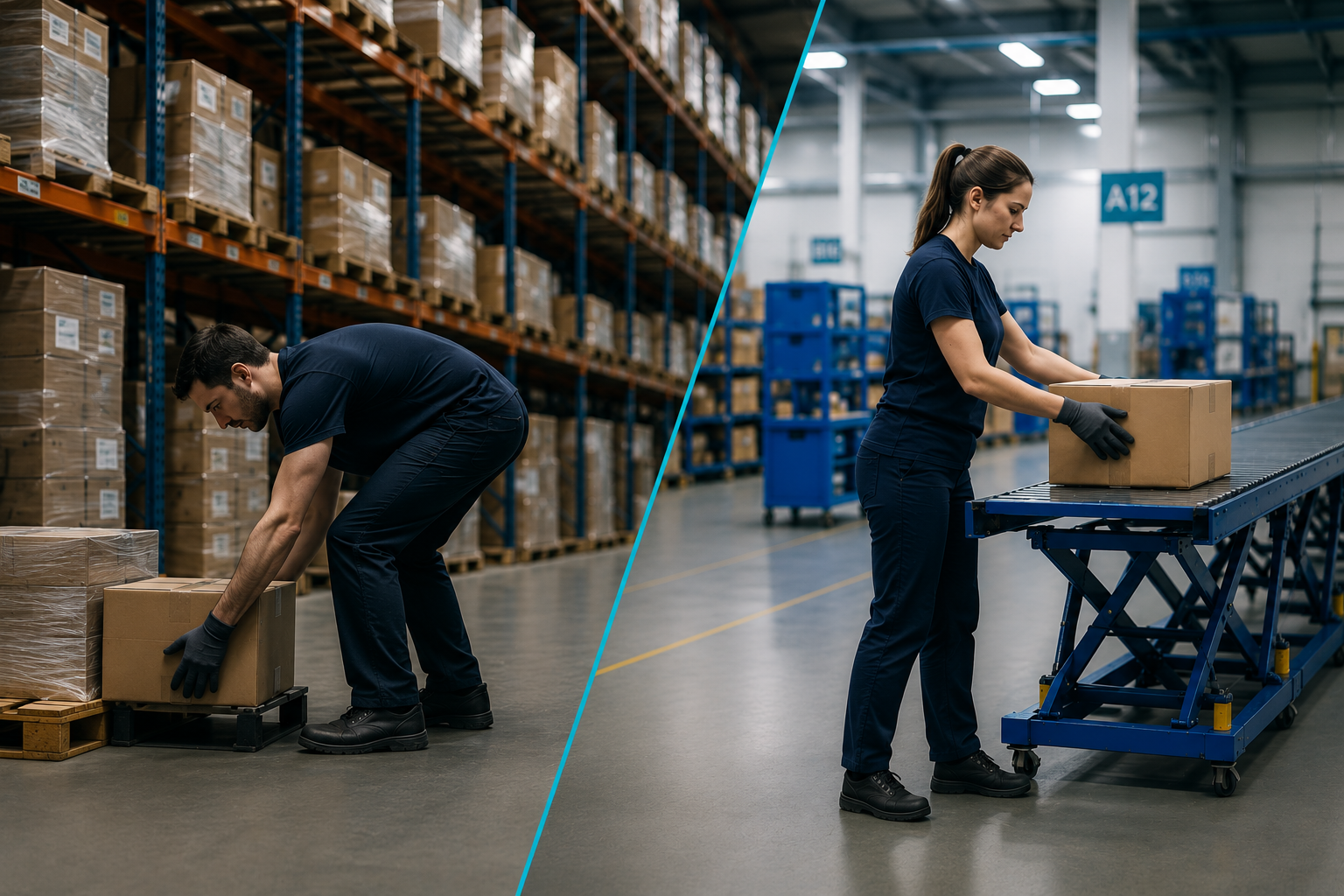
A warehouse operator in Bremen and a warehouse operator in Chicago may have exactly the same job title.
Both work in order picking.
Both complete eight-hour shifts.
Both handle cartons.
Both use handheld scanners.
Both work toward similar productivity targets.
On an organizational chart, they perform the same job.
Their bodies may experience two completely different working days.
One employee picks lightweight products stored primarily between waist and shoulder height. The other repeatedly handles heavier cartons from floor-level locations.
One walks long distances between picks but performs relatively few lifts. The other works in a compact picking zone and completes hundreds of short, repetitive handling cycles.
One has enough space to position the body directly in front of a pallet. The other works around a conveyor, rack, or container that requires repeated reaching and trunk rotation.
The job title is the same.
The physical workload is not.
This distinction matters because industrial companies frequently organize occupational risk around jobs, departments, or standardized processes.
Warehouse picker.
Material handler.
Packer.
Production operator.
These categories are useful for workforce planning.
They are much less precise when the objective is to understand physical workplace exposure.
The physical demands of industrial work are shaped by how a task is actually performed: the weight and dimensions of the load, the position of the worker, the height of the shelf, the frequency of movement, the distance travelled, the layout of the workstation, the pace of work, and the duration of exposure.
Two sites can follow the same standard operating procedure and still expose employees to very different physical demands.
For companies operating multiple warehouses or industrial facilities, this creates a difficult question:
How comparable are supposedly identical jobs?
Physical workload describes the physical demands placed on a worker while performing a job or task.
In warehouse operations, physical workload can be influenced by lifting, carrying, pushing, pulling, bending, reaching, repetitive movement, static postures, walking, and the force required to handle products or equipment.
The UK Health and Safety Executive defines manual handling broadly as transporting or supporting a load by hand or bodily force. This includes lifting, putting down, pushing, pulling, carrying, and moving loads.
However, the presence of manual handling alone does not describe the level of physical risk.
A 10-kilogram carton lifted once is not the same exposure as the same carton handled hundreds of times.
A product picked from waist height does not create the same movement pattern as a product retrieved from floor level.
A push task performed with well-maintained equipment on a smooth surface differs from the same task performed with damaged wheels or across an uneven floor.
This is why physical workload should not be understood as a fixed characteristic of a job title.
It is the result of the interaction between the worker, the task, the load, the equipment, the environment, and the organization of work.
Job descriptions simplify work.
They have to.
Human resources, operations, and workforce planning systems need standardized categories.
The problem begins when those categories are used as substitutes for exposure data.
Consider the job title "order picker."
At one distribution center, order pickers may primarily handle small consumer products using a cart.
At another facility, employees may pick automotive components with highly variable dimensions.
A grocery distribution center may combine low-level picking, cold environments, and high task frequency.
A furniture warehouse may involve fewer handling cycles but significantly larger and more awkward loads.
Even within the same company, product mix can change the physical nature of a job.
The warehouse management system may classify all four employees as order pickers.
An ergonomic risk assessment should not assume that their physical exposure is equivalent.
This is the job description problem: organizations know what employees are called, but may have limited visibility into how physical work actually differs between sites, shifts, or processes.
Imagine the same carton stored in three different locations.
The first is positioned close to floor level.
The second is stored around waist height.
The third is located on a high shelf.
The product has not changed.
The weight has not changed.
The employee has not changed.
But the task has.
Low storage locations may require greater trunk flexion or lower working postures. Higher locations can increase reaching and upper-limb demands. The position of a load relative to the body influences how it can be handled.
Research into warehouse shelf-stocking and binning has specifically examined differences in postural and ergonomic risk associated with high- and low-shelf tasks.
A 2022 study of manual material handling in warehouse binning processes evaluated high-shelf and low-shelf work and identified ergonomic concerns associated with the different storage positions.
More broadly, occupational safety authorities consistently recognize awkward postures, reaching, bending, heavy lifting, and repetitive tasks as relevant risk factors for work-related musculoskeletal disorders.
This has a direct implication for warehouse design.
Storage assignment is not only a logistics decision.
It can also be a physical workload decision.
If high-frequency products are repeatedly stored in physically demanding locations, the warehouse may systematically reproduce the same movement pattern hundreds or thousands of times.
The problem may not be how the employee performs the pick.
The problem may be where the product was placed.
Warehouse performance teams spend considerable time analyzing product mix.
SKU velocity.
Order frequency.
Product dimensions.
Inventory turnover.
Seasonality.
These variables influence storage, labor planning, and throughput.
They also influence physical workload.
A warehouse processing thousands of lightweight products creates a different exposure profile from a facility handling fewer but heavier or awkwardly shaped items.
The difference becomes even more important when product mix changes over time.
A distribution center may complete an ergonomic assessment in March.
Six months later, a major customer is added.
The facility still performs "order picking."
But the average load, handling frequency, packaging dimensions, and storage locations may have changed.
The original job description remains accurate.
The original exposure profile may not.
Recent research into physically demanding order picking has highlighted the importance of order attributes in worker physical exertion. A 2024 study examining what makes order picking physically demanding found that attributes of the orders being picked were important in determining perceived physical exertion.
For multi-site organizations, product mix is therefore one reason identical processes may produce different physical demands.
The question is not only:
How many units does this site process?
It is also:
What are people physically doing to process those units?
Industrial ergonomics often becomes overly focused on individual movements.
A photograph shows an employee bending.
A video captures a shoulder reach.
An observer identifies a lift.
These observations can be useful.
But physical exposure is not defined by posture alone.
Frequency matters.
Duration matters.
Recovery matters.
A movement performed five times during a shift has a different significance from the same movement repeated every minute.
This is particularly relevant in warehousing, where process optimization can increase task frequency without visibly changing the task.
Imagine a picking process is redesigned.
Walking distance decreases.
Products are placed closer together.
The employee can complete more picks per hour.
From a logistics perspective, the process has improved.
The physical question is more complex.
Has the redesign reduced unnecessary walking?
Has it increased handling frequency?
Are the same joints and body regions now exposed to more repeated movements?
Has recovery time between physically demanding actions changed?
There is no automatic answer.
The redesign may improve both productivity and ergonomics.
It may improve one and worsen the other.
The important point is that cycle-time optimization changes human exposure.
Research on productive and ergonomic order picking has argued for integrating health risk and energy expenditure into warehouse optimization rather than evaluating picking time alone.
This is an important shift in warehouse thinking.
The fastest process is not automatically the best-designed process.
Warehouse layout is normally discussed in terms of material flow.
Where should inventory be stored?
How can travel distance be reduced?
Where should receiving and outbound areas be located?
How can congestion be minimized?
These are essential operational questions.
But every warehouse layout also designs human movement.
The distance between a worker and a product influences reaching.
The depth of a pallet influences access.
The height of a rack influences posture.
The location of frequently picked products influences repetition.
Available floor space influences how employees position themselves before handling a load.
The interaction between conveyors, carts, pallets, and racks can determine whether an employee can face a load directly or repeatedly rotate during handling.
These details can create meaningful differences between facilities.
A corporate process may state that employees pick a product, scan it, and place it on a conveyor.
At Site A, the conveyor is positioned directly beside the employee.
At Site B, the employee rotates to place every item behind the body.
The process map looks identical.
The movement pattern is not.
This is why warehouse layout should be understood as a form of human movement design.
Every meter, shelf, conveyor, and workstation influences how work is physically performed.
Physical workload differences do not only exist between warehouses.
They can exist between shifts in the same building.
The morning shift may process a different order profile from the evening shift.
One team may have more experienced employees.
A night shift may operate with fewer maintenance resources.
Temporary workers may be concentrated during seasonal peaks.
Replenishment activities may create different handling requirements at specific times.
Even equipment availability can change the physical demands of work.
If a lifting aid is unavailable, employees may adopt a temporary manual process.
If a preferred cart is being repaired, another piece of equipment may require greater pushing force.
If congestion increases during a particular operating window, employees may have less space to position themselves effectively.
A risk assessment conducted during one shift may therefore capture only one version of the job.
This creates a sampling problem.
The organization believes it has assessed the task.
In reality, it may have assessed Tuesday morning.
Large industrial organizations value standardization.
For good reason.
Standard procedures improve consistency.
Corporate safety standards establish minimum expectations.
Common training supports workforce mobility.
Shared risk assessment frameworks make facilities easier to compare.
But physical work remains local.
The same corporate process enters a different building, meets a different product mix, interacts with different equipment, and is performed by a different workforce.
Standardization can therefore create a false sense of comparability.
The organization may know that every site has completed a manual handling assessment.
That does not mean every site has the same exposure.
The more useful question is whether the assessment process is sensitive enough to identify local differences.
HSE warehouse guidance recommends identifying tasks that present the greatest manual handling risk and involving employees in identifying hazardous lifting and moving jobs.
This local perspective matters.
Employees often know which task is "the bad one."
The pallet that is difficult to access.
The product nobody wants to pick for an entire shift.
The cart that becomes difficult to push when fully loaded.
The workstation that works well for one product and poorly for another.
These observations are operational data.
Organizations should treat them that way.
Traditional ergonomic assessments are valuable tools.
Methods such as RULA, REBA, the NIOSH Lifting Equation, and the HSE Manual Handling Assessment Charts can help professionals evaluate specific physical risk factors.
The challenge is not the existence of these methods.
The challenge is selecting the right task and the right moment to assess.
If work varies significantly, a short observation may not represent typical exposure.
An ergonomist may observe an employee handling light products while the most demanding orders are processed later in the shift.
A site assessment may focus on the primary process while temporary workarounds receive less attention.
One employee may demonstrate the documented method while colleagues normally adapt the task differently.
This does not make observational assessment ineffective.
It means task variability should be part of the assessment strategy.
Before assessing a physical task, organizations should ask:
How much does this work vary?
Do product weights change?
Do storage locations change?
Does frequency change during peak periods?
Do different shifts perform the task differently?
Are there temporary processes?
Do employees use different movement strategies?
Which version of the task represents the highest exposure?
A precise assessment of the wrong moment can still create an incomplete picture.
This leads to a problem that many multi-site industrial organizations face without having a clear name for it.
We call it the physical exposure gap.
The physical exposure gap is the difference between how an organization defines a job and the physical demands workers actually experience while performing that job across real operating conditions.
The gap can emerge through differences in layout, product mix, shelf height, task frequency, equipment, shift conditions, work methods, or local process adaptations.
The larger the gap, the less useful job titles and standardized process descriptions become for understanding physical risk.
This concept helps explain why organizations sometimes struggle with apparently inconsistent ergonomic outcomes.
Two sites may employ the same number of warehouse pickers.
One site reports recurring shoulder concerns.
Another sees more lower-back complaints.
A third has relatively few reported issues.
The first assumption may be that employees behave differently.
A better investigation starts with exposure.
What are people lifting?
Where are they reaching?
How frequently?
For how long?
Under which operating conditions?
The body responds to physical exposure.
It does not respond to a job title.
The solution is not to abandon standardized job categories.
The solution is to add an exposure perspective.
Organizations can begin by identifying tasks rather than job titles.
Instead of assessing "warehouse picker," separate the work into meaningful physical activities.
Low-level picking.
High-shelf picking.
Pallet handling.
Cart pushing.
Container unloading.
Repetitive packing.
Manual replenishment.
Each activity can then be examined in its actual operational context.
The next step is to identify variability.
Which loads change?
Which tasks increase during peak periods?
Which sites use different layouts?
Where do employees perform the same process with different equipment?
Which tasks show significant differences between shifts?
Organizations should then compare exposure patterns across sites.
The objective is not to create a league table of "good" and "bad" warehouses.
The objective is to find meaningful differences.
If one site has lower physical exposure during a comparable process, why?
Is the layout different?
Are high-frequency products stored differently?
Is a mechanical aid available?
Does the site rotate tasks?
Has the process been locally redesigned?
This turns multi-site comparison into a source of ergonomic learning.
The best-performing site may already contain the solution to a problem elsewhere in the organization.
Industrial companies have become exceptionally good at measuring output.
Units per hour.
Pick rate.
Cycle time.
Travel distance.
Order accuracy.
Equipment utilization.
The physical side of work is often measured with far less resolution.
Organizations may know exactly how many items an employee processes during a shift while having limited information about the movements required to achieve that output.
This creates an imbalance.
Performance is measured continuously.
Physical exposure is assessed periodically.
For many industrial organizations, the next stage of occupational ergonomics will be closing this information gap.
This does not mean every employee needs to be continuously monitored.
Nor does it mean professional ergonomic judgment should be replaced by technology.
It means organizations need better ways to understand how physical work varies across tasks, sites, and operating conditions.
Digital ergonomic assessments, sensor-based measurements, video analysis, and structured observational methods can all contribute depending on the use case.
The objective should remain the same:
Make physical workload visible enough to support better work design.
For WearHealth, this is where data-driven ergonomics becomes relevant.
Not because artificial intelligence is the objective.
The objective is understanding exposure that standardized job descriptions and short observations may fail to distinguish.
Technology is useful when it helps an ergonomist, EHS team, or operations leader see a difference that matters.
Warehouse leaders do not need to become biomechanists.
But they should challenge the assumption that standardized work automatically creates standardized physical exposure.
Ask whether the same job is physically performed in the same way across sites.
Ask which product characteristics create the highest physical demands.
Ask whether high-frequency items are stored in locations that repeatedly require demanding postures.
Ask how physical workload changes during peak season.
Ask whether night and day shifts experience the same task conditions.
Ask employees which processes feel most physically demanding and why.
Ask whether the organization measures task variability before selecting an ergonomic assessment method.
And when two sites show different occupational health outcomes, ask about exposure before assuming the difference is behavior.
These questions move the discussion away from generic manual handling advice.
They focus attention on the design of work.
Companies need job titles.
They need standardized processes.
They need corporate safety frameworks.
But none of these describes physical workload with sufficient precision on its own.
The body experiences the shelf height.
The load.
The reach.
The frequency.
The duration.
The available space.
The equipment.
The pace of work.
Two employees can perform the same job and experience very different physical demands.
For multi-site warehouse and industrial organizations, recognizing this difference is the first step toward more precise ergonomic risk management.
The question should no longer be:
Have we assessed the warehouse picker role?
A better question is:
Do we understand how warehouse picking is physically experienced across our real operating conditions?
The difference between those questions is the physical exposure gap.
And closing that gap may reveal risks—and opportunities for better work design—that job descriptions were never designed to show.
The same warehouse job can create different ergonomic risks because physical workload depends on task frequency, load characteristics, shelf height, workplace layout, equipment, working space, and how the task is organized. Employees with the same job title may therefore experience different physical exposures.
Physical workload is the physical demand placed on a worker while performing a task. In warehouses, it can include lifting, carrying, pushing, pulling, bending, reaching, repetitive movement, walking, force, and sustained postures.
Warehouse layout influences where products are stored, how workers access loads, available working space, reaching distance, travel, and body positioning. Layout decisions can therefore change physical movement patterns even when the formal work process remains the same.
Job titles describe organizational roles rather than physical exposure. A job title such as "order picker" does not explain product weight, handling frequency, storage height, movement patterns, or task variability. Ergonomic risk assessment should evaluate actual tasks and working conditions.
The physical exposure gap is the difference between how an organization defines a job and the physical demands employees actually experience under real operating conditions. Differences in layout, product mix, frequency, equipment, and local work methods can increase this gap.
To understand how broader warehouse safety systems are structured, read "Safety Management for Distribution Centers: Why Some Warehouses Consistently Outperform Others."
For the operational consequences of occupational injuries, continue with "The Hidden Costs of Workplace Injuries: What Safety Reports Often Miss."
For a faster way to identify physical workplace exposure, explore "Instant Ergonomic Risk Assessment: Identify Workplace Exposure in Minutes with ErgoScan AI."
Health and Safety Executive. Warehousing and Storage: Manual Handling.
Health and Safety Executive. Manual Handling at Work.
European Agency for Safety and Health at Work. Musculoskeletal Disorders.
Federal Institute for Occupational Safety and Health. Health and Physical Workloads.
Zhao, Y. S. et al. Ergonomics Risk Assessment for Manual Material Handling of Warehouse Activities Involving High-Shelf and Low-Shelf Binning Processes. Sustainability, 2022.
Gajšek, B. et al. Towards Productive and Ergonomic Order Picking: Multi-Objective Modeling Approach. Applied Sciences, 2021.
De Lombaert, T. et al. What Makes Order Picking So Physically Demanding? IFAC-PapersOnLine, 2024.
mehr Einblicke
August 18, 2026
How can warehouse managers determine whether an ergonomics tool will work in their operation? Learn how to evaluate solutions through real-world pilots, usability, workflow integration and privacy.
August 17, 2026
What can manufacturers learn from Nissan’s investment in ergonomics? Explore why physical workload is becoming an important part of production and workstation design.
