


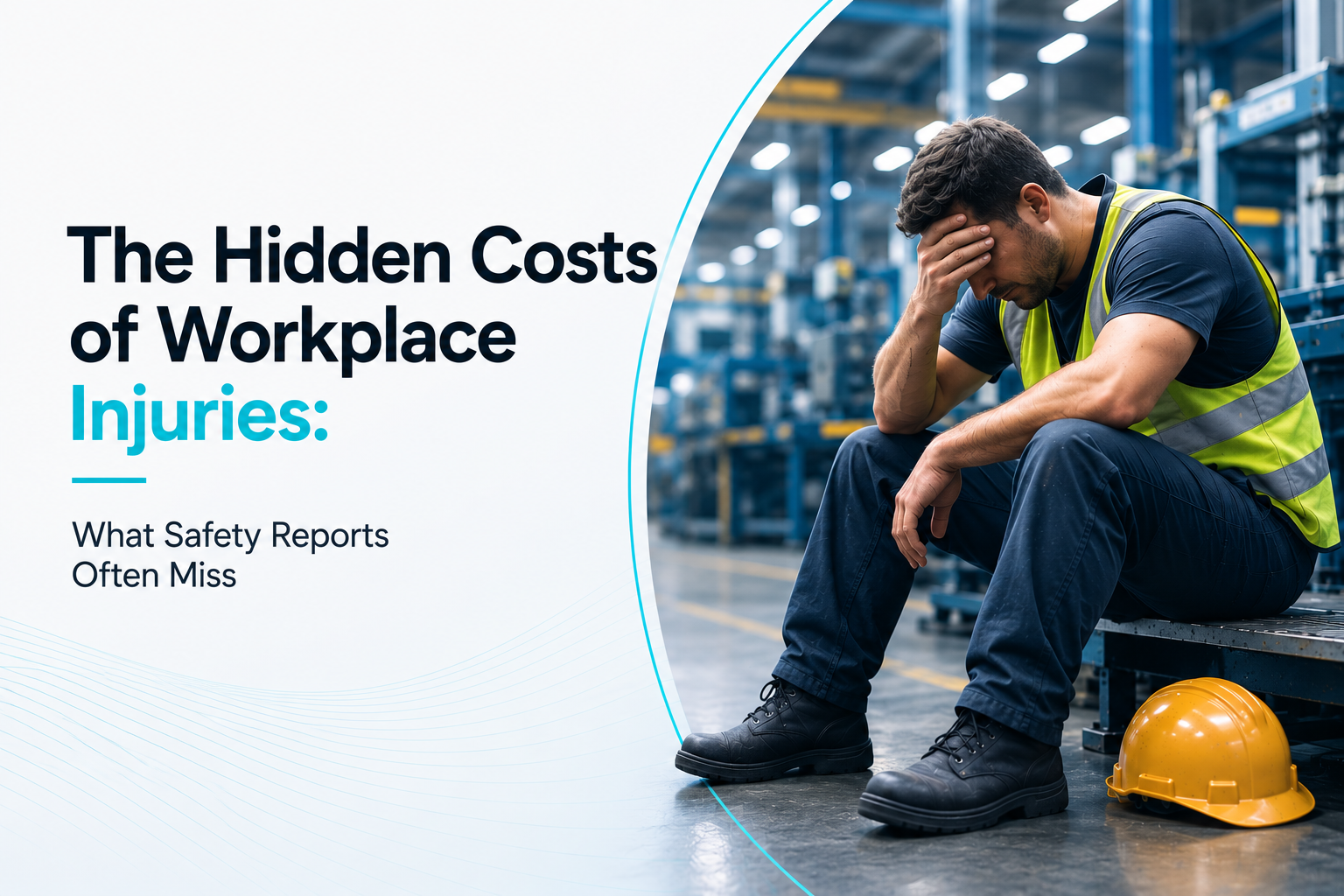
A workplace injury rarely ends when the incident report is closed.
The employee may leave the operation. A supervisor reorganizes the shift. Overtime is approved. Another worker is moved from a different area. Human resources begins a replacement process. Safety starts an investigation. Operations reviews the task. Maintenance checks the equipment. Management asks for an explanation.
None of these activities may appear under the same cost center.
Together, they form the operational cost of a workplace injury.
Most companies are relatively good at identifying the visible costs of occupational injuries. Medical expenses, workers' compensation payments, insurance claims, and legal costs can usually be assigned a value.
The less visible consequences are harder to measure.
Lost experience.
Temporary productivity gaps.
Additional supervision.
Replacement training.
Schedule disruption.
Management time.
Higher overtime.
Reduced team stability.
These costs are distributed across an organization. As a result, the true business impact of workplace injuries is often significantly more complex than the number shown in a safety report.
The problem is not that companies ignore injury costs.
The problem is that they often measure only the costs that are easiest to see.
The hidden costs of workplace injuries are indirect operational expenses and business disruptions that occur because of an incident but are not always recorded as part of the injury claim.
According to OSHA's business case for safety and health, workplace injuries can create both direct and indirect costs. Direct costs include expenses such as workers' compensation payments, medical costs, and legal services. Indirect costs can include replacement training, accident investigation, corrective measures, lost productivity, schedule delays, administrative time, and damage to equipment or property.
This distinction matters because indirect costs rarely arrive as one invoice.
They appear across the business.
A warehouse manager sees overtime.
HR sees recruitment and onboarding.
Operations sees lower output.
The safety team sees investigation hours.
Finance sees several small cost increases in different departments.
Senior management may never see the complete picture.
This creates what could be called the injury cost visibility gap: the difference between the costs an organization formally attributes to a workplace injury and the wider operational consequences created by the same event.
Imagine an experienced employee in a distribution center is unable to work after an occupational injury.
The formal safety record captures the incident.
The insurance process captures the claim.
But the operation still needs to run.
The employee's work does not disappear simply because the employee is absent.
Someone must absorb it.
A colleague may work additional hours. A temporary worker may be assigned to the area. A supervisor may spend more time supporting the shift. Production targets may be adjusted. Other employees may be moved between processes.
The business begins compensating for the absence.
This is the first reason workplace injury costs are difficult to understand: operations are designed to keep moving.
Successful operations teams are exceptionally good at solving immediate problems. They reorganize people, adjust schedules, and protect customer commitments.
But operational resilience can hide the true impact of an injury.
The order still ships.
The production line still runs.
The customer may never notice a problem.
Internally, however, the organization may have used overtime, management attention, additional training, and workforce flexibility to maintain the same result.
The disruption has not disappeared.
It has been absorbed.
Not every employee absence has the same operational impact.
An experienced employee carries knowledge that is rarely documented in a standard operating procedure.
They know which process becomes congested during a shift change.
They recognize unusual equipment sounds.
They know when a pallet configuration is likely to create problems.
They understand which product variants require additional attention.
They can often identify a developing operational issue before it becomes visible in a KPI.
This is tacit knowledge: practical knowledge developed through experience.
When an experienced worker leaves an operation temporarily or permanently, the organization does not only lose labor capacity.
It may also lose operational memory.
The replacement employee may be fully trained and technically qualified. But training does not immediately reproduce years of experience.
This creates an experience gap.
The consequences can appear as slower task completion, additional questions, greater supervisory support, or increased process variability.
None of these outcomes necessarily appears in the workplace injury cost calculation.
Yet operations teams feel them immediately.
A common assumption is that an absent employee can be replaced by another employee.
From a headcount perspective, this may be correct.
From an operational perspective, replacement is rarely immediate.
A new or temporary employee needs onboarding.
They need to understand the facility.
They need to learn the task.
They need to become familiar with equipment and procedures.
They need to understand the informal coordination that allows a team to work efficiently.
During this period, the organization experiences a replacement productivity gap: the difference between having a person assigned to a role and having a fully experienced employee performing that role consistently.
The gap may last days, weeks, or longer depending on the complexity of the work.
The effect is particularly important in industrial operations with high workforce turnover or repeated absence.
If organizations continuously replace experienced employees, they may operate with a permanently reduced level of workforce experience.
This can become a structural performance issue rather than a temporary staffing problem.
Overtime is usually recorded as a labor expense.
But the reason for the overtime matters.
When additional hours are required to compensate for injury-related absence, part of the labor cost is also a consequence of the incident.
The financial impact is only one consideration.
Long work hours can influence performance and fatigue. NIOSH guidance on work schedules notes that extended work hours can be associated with reduced productivity, increased errors, absenteeism, and turnover.
This creates a difficult operational cycle.
An injury reduces workforce capacity.
Remaining employees work additional hours.
The operation becomes more dependent on overtime.
Workforce pressure increases.
Management has less flexibility when the next absence or operational disruption occurs.
This does not mean overtime automatically creates workplace injuries.
It means staffing pressure and work schedules should be considered when organizations evaluate the broader consequences of occupational incidents.
An injury can change the operating conditions for employees who were not involved in the original event.
That secondary effect is rarely visible in traditional injury cost reporting.
Every organization has a limited amount of management attention.
A serious workplace incident consumes it quickly.
Supervisors participate in interviews.
Safety professionals collect information.
Operations managers review processes.
Senior leaders request updates.
HR may become involved.
Engineering or maintenance may evaluate corrective measures.
Meetings are scheduled.
Reports are prepared.
Actions are assigned.
Follow-up reviews are conducted.
These activities are necessary.
A serious incident deserves a serious investigation.
The hidden cost is opportunity cost.
Every hour spent responding to a preventable incident is an hour that cannot be spent on process improvement, employee development, capacity planning, customer issues, or other strategic priorities.
Management time does not normally appear in an injury claim.
It remains one of the most valuable resources consumed by workplace incidents.
For large organizations, this effect can multiply.
If multiple sites repeatedly experience similar incidents, local and corporate safety teams may spend significant time investigating variations of the same underlying problem.
At that point, the organization is not only paying for incidents.
It is using management capacity to repeatedly rediscover them.
Industrial operations depend on predictable processes.
Workplace incidents introduce uncertainty.
A task may be temporarily stopped.
Equipment may be removed from service.
A work area may require inspection.
Employees may be reassigned.
A process may operate under temporary restrictions while an investigation is completed.
Even when the disruption is brief, it can affect connected processes.
In a distribution center, a delay in one picking area may influence packing.
Packing delays can affect staging.
Staging delays can create pressure at outbound loading.
In manufacturing, a disruption at one workstation may influence downstream processes, material flow, or production schedules.
This is why the operational cost of an injury should not always be evaluated at the location where the injury occurred.
Industrial systems are connected.
The consequences can travel through the operation.
Workplace injuries affect more than the employee who was injured.
Colleagues notice what happens.
They see whether management responds.
They observe whether known problems are corrected.
They notice when a colleague returns to the same task without meaningful changes.
These observations influence trust.
Research and occupational health guidance have long connected working conditions with absenteeism, turnover, and employee wellbeing. For industrial employers already facing skilled labor shortages, workforce stability is becoming an increasingly important business issue.
A company can replace a person.
Replacing team stability is harder.
High employee turnover creates its own operational costs: recruitment, onboarding, training, supervision, and lost experience.
When occupational risk contributes to workforce dissatisfaction or repeated absence, safety can indirectly become a retention issue.
This does not mean every employee resignation is caused by workplace safety.
The more useful question is whether organizations are examining the relationship at all.
If one physically demanding department has higher absence, higher turnover, and recurring safety concerns than comparable departments, these signals should not be analyzed in isolation.
The pattern may contain useful information about how work is designed.
The fundamental problem is organizational fragmentation.
Companies are structured into departments.
Incidents are not.
One workplace injury can influence safety, operations, HR, finance, maintenance, and management simultaneously.
Each department records its own consequences.
The safety team records the incident.
Finance records direct expenses.
Operations records overtime.
HR records recruitment.
Training records onboarding.
Management absorbs additional meetings.
Because the data remains separated, the organization may underestimate the total effect.
The injury creates a chain reaction.
Traditional reporting captures individual links.
The strategic opportunity is to understand the chain.
Organizations do not need a perfect financial model to improve injury cost visibility.
They need a broader question.
Instead of asking only, "What did the claim cost?", management can ask:
"What did the organization have to do differently because this injury occurred?"
That question changes the analysis.
Did the facility require overtime?
Was a replacement employee hired?
How much onboarding was required?
Did supervisors spend additional time supporting the process?
Was production interrupted?
Were other employees reassigned?
Did maintenance or engineering implement corrective changes?
How many management hours were used for investigation and follow-up?
Did the absence influence customer commitments or production planning?
Not every consequence needs to be converted into a precise financial value.
The first objective is visibility.
Organizations cannot manage costs they do not recognize.
OSHA's Safety Pays tools similarly illustrate the broader business logic by allowing employers to estimate how occupational injury and illness costs can affect profitability and the additional sales required to cover those costs.
The principle is straightforward.
Revenue must be earned.
Preventable cost does not.
There is no universal number that accurately describes the indirect cost of every workplace injury.
A minor incident in one operation may create little disruption.
The same type of absence in another facility may remove a highly specialized employee from a critical process.
Context matters.
The operational impact depends on factors such as workforce availability, task specialization, production schedules, overtime capacity, labor market conditions, process dependencies, and the availability of trained replacements.
This is why generic statements such as "indirect costs are always X times higher than direct costs" should be treated carefully.
For serious business decisions, organizations should analyze their own operations.
A distribution center with high temporary labor availability may experience a different replacement cost than a specialized manufacturing site where technical training takes months.
A global company may be able to share safety resources across sites.
A smaller operation may depend on one safety manager.
The more specific the analysis becomes, the more useful it is.
There is an important difference between calculating injury costs and understanding prevention economics.
Injury cost analysis looks backwards.
Prevention economics asks where an organization can reduce future operational loss.
Suppose one work area repeatedly experiences absence, employee turnover, and occupational health concerns.
Management could evaluate the direct cost of previous incidents.
A stronger analysis would also examine the operational burden created by the area.
How much overtime is associated with absence?
How frequently are employees replaced?
How much supervisory time is required?
How often does the task appear in safety investigations?
How much operational variability is connected to the process?
This creates a more complete business case for intervention.
The investment decision is no longer based only on avoiding one future injury.
It considers the wider operational burden of the current process.
For occupational ergonomics, this distinction is particularly relevant. NIOSH notes that ergonomics programs can help prevent losses in productivity, quality, and profit while lowering absenteeism and lost time.
The purpose of prevention should not be to attach a financial value to human health.
The purpose is to help organizations recognize that preventable occupational risk creates consequences across the business.
Safety teams often understand occupational risk.
Operations understands process disruption.
HR understands workforce availability.
Finance understands cost.
The problem is that these perspectives are frequently discussed separately.
A more useful management conversation begins with one question:
Where is preventable occupational risk creating repeated operational cost?
The answer may not be found in the injury rate alone.
It may appear in overtime.
Absence.
Turnover.
Repeated onboarding.
Process interruptions.
Corrective actions.
Management time.
The objective is not to turn every workforce issue into a safety issue.
It is to identify relationships that departmental reporting can hide.
This is where safety data becomes strategically valuable.
Not as another dashboard.
As context for business decisions.
For senior leaders, the main lesson is simple.
The cost of a workplace injury is not equal to the cost of the claim.
The claim is one part of the event.
The wider impact depends on how the organization compensates for the disruption.
Industrial companies should therefore examine three levels of injury impact.
First, the direct consequence: medical costs, claims, and formal expenses.
Second, the operational response: overtime, replacement, training, supervision, and process changes.
Third, the organizational effect: workforce stability, management capacity, and recurring operational disruption.
Looking at all three levels creates a more realistic picture of workplace injury costs.
It also changes how prevention investments are evaluated.
A safety intervention that prevents one claim may be valuable.
An intervention that also reduces absence, stabilizes a process, lowers repeated onboarding, and frees management capacity may have a much broader business impact.
Companies measure what their systems are designed to record.
Workers' compensation systems record claims.
Finance systems record expenses.
HR systems record absence.
Operations systems record overtime and output.
Safety systems record incidents.
A workplace injury can influence all of them.
The challenge is that no single system tells the complete story.
This is why the hidden costs of workplace injuries remain hidden.
They are not invisible.
They are fragmented.
The organizations that understand this will begin evaluating occupational risk differently.
They will look beyond the claim.
They will examine the operational response.
They will ask where workforce capacity is being absorbed, where management time is being consumed, and where repeated disruption has become normalized.
The question is no longer simply:
How much did this injury cost?
The better question is:
What did our business have to absorb because this injury occurred?
That is where the real cost of workplace injuries begins.
The hidden costs of workplace injuries are indirect operational consequences that may not appear in the formal injury claim. They can include overtime, replacement training, lost productivity, management time, accident investigation, schedule disruption, additional supervision, and workforce instability.
Direct workplace injury costs generally include identifiable expenses such as workers' compensation payments, medical costs, and legal services. Indirect costs arise from the organization's response to the incident and may include lost productivity, replacement training, investigation time, corrective actions, and operational disruption.
Companies often underestimate workplace injury costs because the consequences are recorded across different departments. Safety records the incident, operations records overtime, HR records absence or recruitment, and finance records direct expenses. Without connecting these data points, the full operational impact can remain fragmented.
Companies can start by examining what the organization had to do differently because the injury occurred. This includes reviewing direct expenses, overtime, employee replacement, onboarding, management hours, process interruptions, corrective actions, and other operational changes connected to the incident.
Workplace injury prevention can support business performance by reducing avoidable disruption, absence, replacement requirements, and lost operational capacity. The specific impact depends on the organization, workforce, and type of work.
For a broader management perspective, read Safety Management for Distribution Centers: Why Some Warehouses Consistently Outperform Others.
To understand how organizations can identify physical workplace exposure, explore Instant Ergonomic Risk Assessment: Identify Workplace Exposure in Minutes with ErgoScan AI.
Explore more research, practical guidance, and industrial safety insights in the WearHealth Workplace Safety & Ergonomics Blog.
Occupational Safety and Health Administration. Business Case for Safety and Health: Costs.
Occupational Safety and Health Administration. Safety Pays Individual Injury Estimator.
National Institute for Occupational Safety and Health. Elements of Ergonomics Programs.
More Insights
August 18, 2026
How can warehouse managers determine whether an ergonomics tool will work in their operation? Learn how to evaluate solutions through real-world pilots, usability, workflow integration and privacy.

August 17, 2026
What can manufacturers learn from Nissan’s investment in ergonomics? Explore why physical workload is becoming an important part of production and workstation design.
