


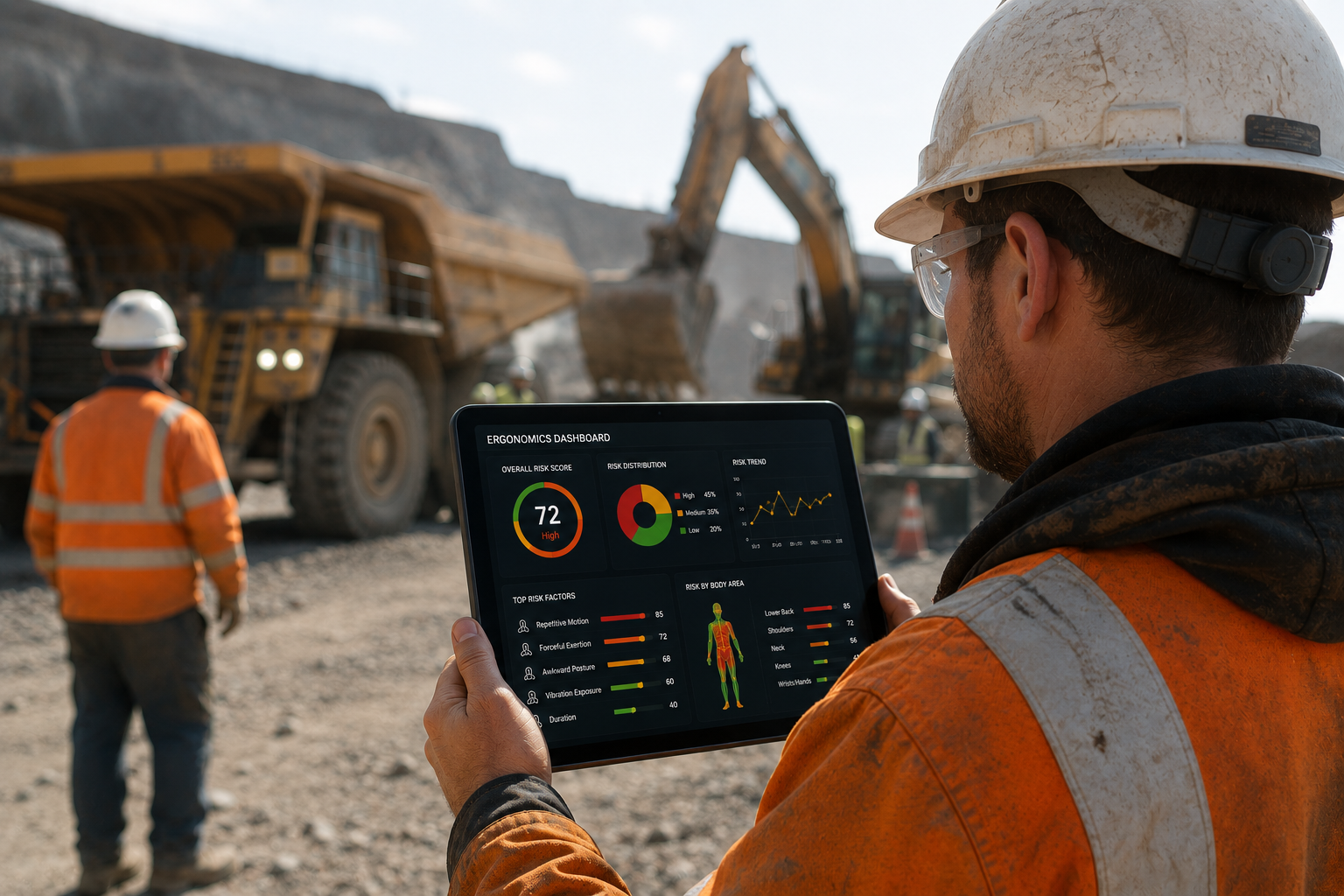
Mining remains one of the world's most physically demanding industries. Whether employees operate haul trucks, maintain heavy equipment, or work inside processing plants, they are exposed to continuous ergonomic stress throughout every shift. Repetitive lifting, awkward postures, vibration, confined workspaces, and physically demanding maintenance tasks place enormous strain on the musculoskeletal system.
As mining companies increase production while facing labor shortages and stricter safety regulations, reducing ergonomic risk has become far more than a compliance objective. It has become a business priority.
Traditional ergonomics programs were designed for occasional inspections and paper-based assessments. Modern mining operations require something fundamentally different: continuous visibility into how work is actually performed across multiple sites, changing shifts, and demanding environments.
This guide explores how AI-powered mining ergonomics helps organizations identify hidden biomechanical risks, improve worker wellbeing, reduce musculoskeletal disorders (MSDs), and build safer, more productive mining operations through predictive safety intelligence.
Modern mining is more technologically advanced than ever before, yet many daily tasks still rely heavily on manual work.
Across surface and underground operations, workers routinely perform physically demanding activities that include:
Unlike manufacturing environments with standardized production lines, mining conditions constantly change. Uneven terrain, weather, equipment breakdowns, restricted access, and long shifts create highly variable ergonomic demands that traditional safety assessments struggle to capture.
The result is a steady accumulation of physical strain that often goes unnoticed until pain, reduced mobility, or recordable injuries occur.
For many organizations, the largest ergonomic risks are no longer catastrophic accidents but thousands of small biomechanical stresses repeated every day.
Musculoskeletal disorders affect far more than worker health.
Poor ergonomics can lead to:
Experienced technicians and equipment operators are among the mining industry's most valuable assets. When these skilled employees are unavailable because of preventable injuries, production schedules become more difficult to maintain and replacement costs rise significantly.
Investing in mining ergonomics therefore delivers value beyond safety metrics by protecting workforce capability and improving operational resilience.
Every mining environment presents unique physical demands, but several ergonomic hazards consistently contribute to musculoskeletal disorders.
Operators of haul trucks, loaders, bulldozers, and excavators spend long hours seated while being exposed to continuous whole-body vibration.
Combined with limited movement and awkward cabin positioning, prolonged vibration increases fatigue and places sustained stress on the lower back, neck, and shoulders.
Cab design, seat adjustment, visibility, and operator posture all influence long-term ergonomic outcomes.
Maintenance teams often experience the highest physical workload on site.
Routine repairs require mechanics to:
Because maintenance work is unpredictable, technicians frequently adopt awkward postures that cannot be eliminated through traditional safety training alone.
These tasks benefit significantly from objective ergonomic assessment and workflow redesign.
Although mining is increasingly mechanized, workers still manually move tools, replacement parts, hoses, pumps, and equipment throughout the site.
Repeated lifting, carrying, pushing, and pulling create cumulative loading on the spine and upper body, particularly during shutdowns and maintenance projects where work intensity increases dramatically.
While manual lifting is often associated with musculoskeletal disorders, prolonged exposure to whole-body vibration (WBV) is one of the most significant ergonomic risks in mining.
Operators of haul trucks, wheel loaders, bulldozers, graders, and drilling equipment spend entire shifts exposed to continuous vibration generated by rough terrain, uneven haul roads, and heavy machinery.
Over time, this constant exposure can contribute to:
Because these symptoms develop gradually, vibration-related injuries often remain unnoticed until they begin affecting worker performance and attendance.
Reducing vibration exposure requires more than improved seating. Equipment maintenance, haul road conditions, suspension systems, operator rotation, and cab ergonomics all play critical roles in minimizing long-term spinal stress.
Although every mining operation presents physical demands, underground and surface environments expose workers to different ergonomic hazards.
Underground operations frequently involve:
These conditions increase static muscle loading and force workers into awkward postures that are difficult to avoid during maintenance and production activities.
Surface operations generally provide more space but introduce different challenges.
Workers often perform repetitive climbing on heavy equipment, walk long distances across uneven terrain, handle large components during field maintenance, and operate mobile machinery for extended periods.
Environmental conditions such as heat, dust, vibration, and weather further increase physical fatigue throughout the shift.
Because the ergonomic demands differ significantly, effective mining ergonomics programs should be tailored to each work environment rather than applying a single standardized assessment.
Physical fatigue is one of the strongest predictors of ergonomic risk.
As shifts progress, workers naturally compensate for tired muscles by changing how they lift, bend, reach, and carry materials.
These subtle movement changes often include:
Unfortunately, traditional safety inspections rarely observe workers during these high-fatigue periods.
Continuous movement analysis provides a much more realistic picture of ergonomic exposure throughout an entire shift, helping organizations identify when and where injury risk increases.
Training workers to lift correctly remains important, but training alone cannot eliminate ergonomic hazards.
The most effective mining organizations prioritize engineering controls that reduce physical demands before injuries occur.
Examples include:
Unlike behavioral interventions, engineering improvements remove unnecessary strain from every task performed in the workplace.
This creates permanent reductions in ergonomic risk while improving efficiency for the entire workforce.
Mining operations constantly change.
Equipment is repaired, production schedules shift, crews rotate, shutdowns occur, and environmental conditions evolve daily.
As a result, ergonomic risks also change continuously.
Annual audits or occasional workplace observations provide only limited visibility into these changing conditions.
Modern mining organizations increasingly rely on continuous ergonomic monitoring to understand how work is actually performed across different shifts, departments, and operational areas.
Using an AI Ergonomics Risk Scan, safety teams can quickly identify repetitive movements, awkward postures, excessive bending, vibration exposure, and physically demanding tasks that would otherwise remain hidden during traditional inspections.
Instead of relying solely on observations, organizations gain objective movement data that supports better engineering decisions, targeted training, and more effective injury prevention strategies.
This proactive approach allows safety professionals to address risks before they develop into lost-time injuries, improving both workforce wellbeing and long-term operational performance.
Collecting ergonomic data is only the first step. The real value comes from transforming movement information into decisions that improve both worker safety and operational performance.
Modern AI-powered ergonomics platforms continuously analyze how employees interact with equipment, tools, and workstations throughout every shift. Instead of producing isolated assessment reports, they reveal long-term patterns that help safety managers understand where physical strain develops and why.
This allows mining companies to answer critical operational questions such as:
Rather than reacting to injury statistics, organizations gain the ability to prevent ergonomic problems before they affect productivity.
Safety training is most effective when guidance is available during the task—not months after a classroom session.
The AI Ergonomics Coach provides immediate movement feedback whenever workers perform actions associated with elevated biomechanical risk.
This may include:
Instead of interrupting production, workers receive subtle feedback that encourages safer movement patterns throughout normal work activities.
Over time, these small corrections help reduce cumulative strain while reinforcing ergonomic best practices without increasing supervisory workload.
For experienced workers, the technology serves as an additional layer of protection rather than replacing existing safety knowledge.
Successful ergonomics programs should complement existing Environmental, Health and Safety (EHS) systems rather than operate independently.
By combining information from the AI Ergonomics Platform with existing safety metrics, organizations gain a more complete understanding of workplace risk.
This enables safety teams to connect ergonomic performance with operational indicators such as:
Instead of reviewing ergonomics separately, leaders can incorporate movement intelligence into routine operational planning and continuous improvement initiatives.
The result is a proactive safety culture where ergonomic performance becomes part of everyday operational decision-making.
Mining companies increasingly recognize that ergonomics is not simply a compliance requirement—it is an operational performance strategy.
Organizations that proactively reduce physical strain often experience:
By identifying ergonomic risks before they become injuries, companies create healthier workplaces while strengthening long-term operational resilience.
Rather than treating ergonomics as an annual assessment, forward-looking organizations are integrating continuous movement intelligence into their overall operational excellence strategy.
WearHealth helps mining companies achieve this transition through AI-powered ergonomics solutions designed specifically for physically demanding industrial environments.
Mining ergonomics focuses on designing tasks, equipment, and work environments that reduce physical strain on workers. It helps minimize musculoskeletal disorders by improving lifting techniques, workstation design, equipment operation, and manual material handling throughout mining operations.
Maintenance technicians, heavy equipment operators, drill crews, crusher plant workers, conveyor maintenance teams, and material handling personnel typically experience the highest ergonomic exposure due to repetitive movements, vibration, awkward postures, and physically demanding tasks.
Continuous vibration from haul trucks, loaders, excavators, and drilling equipment increases fatigue and places additional stress on the spine. Long-term exposure can contribute to lower back pain, neck discomfort, reduced mobility, and other musculoskeletal disorders if not properly managed.
Yes. AI-powered ergonomics systems continuously analyze movement patterns to identify hazardous postures, repetitive strain, excessive bending, and other ergonomic risks. This allows organizations to intervene before injuries occur and make data-driven improvements to workplace design.
The AI Ergonomics Coach provides immediate feedback whenever workers perform movements associated with elevated ergonomic risk. These real-time reminders help reinforce safer movement habits during everyday work without interrupting productivity.
mehr Einblicke
August 18, 2026
How can warehouse managers determine whether an ergonomics tool will work in their operation? Learn how to evaluate solutions through real-world pilots, usability, workflow integration and privacy.
August 17, 2026
What can manufacturers learn from Nissan’s investment in ergonomics? Explore why physical workload is becoming an important part of production and workstation design.
