


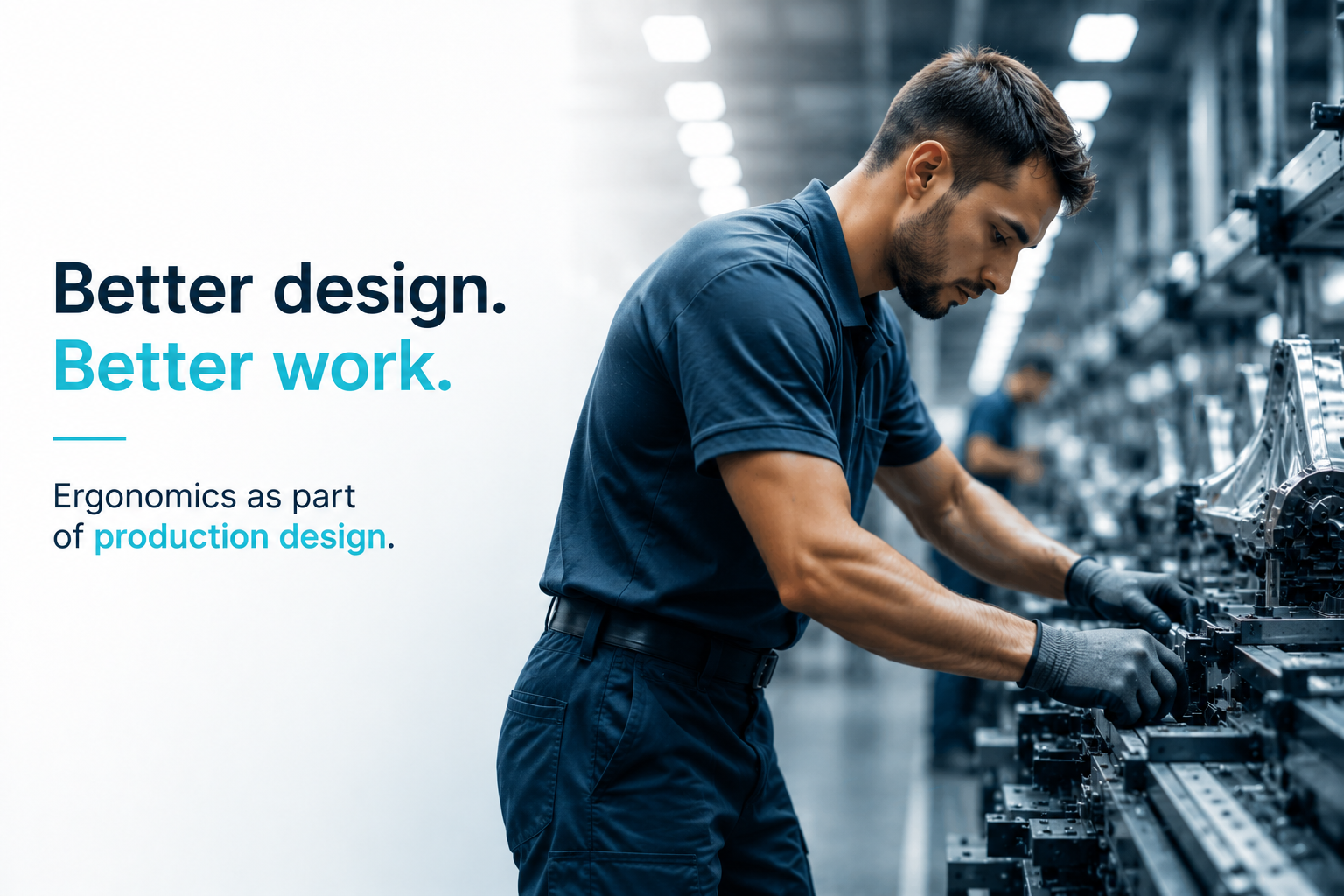
Manufacturing has spent decades making production increasingly measurable. Cycle time, quality, downtime, scrap, equipment utilization and throughput can all be monitored in considerable detail. When performance changes on an assembly line, operations teams can usually identify where the change occurred and investigate which part of the process requires attention.
Physical workload is often less visible.
Manufacturers have long understood that repetitive movements, manual material handling and demanding working postures can contribute to musculoskeletal disorders. Ergonomic assessments and workplace improvements are therefore well-established elements of occupational health and safety. What is changing is not the basic understanding of ergonomic risk, but where ergonomics enters the production process.
A recent example from Nissan illustrates this development. At its manufacturing facility in Canton, Mississippi, the company has invested in identifying physical demands during production and using the resulting information to improve workstations and processes. According to a report published in August 2026, Nissan associates the initiative with approximately $34 million in health- and safety-related savings and intends to expand the approach to its Smyrna facility in Tennessee.
The $34 million figure naturally attracts attention, but it should be interpreted carefully. The publicly available report does not provide a detailed calculation that would allow the figure to be independently verified or show precisely which measures contributed to which portion of the savings. It should therefore be understood as a company-reported result rather than a benchmark that other manufacturers should expect to reproduce.
The more interesting aspect of the Nissan example is what sits behind the headline. Ergonomic information is being used not simply to identify physical strain, but to inform changes to the production environment. According to the report, identified ergonomic issues feed into process improvements and workstation redesign.
That points toward a broader development in industrial production: ergonomics can become an input into production design, rather than an assessment that begins only after the work has already been designed.
The immediate lesson from Nissan is not that every manufacturer should adopt the same approach or expect the same financial outcome. Manufacturing environments differ significantly in their products, processes, workforce characteristics, degree of automation and physical requirements.
The broader lesson is that physical workload can provide information about the production system itself.
Consider a repetitive assembly task. An employee retrieves a component, reaches toward the product, positions the part and returns to the starting position. From an operational perspective, the most visible information may be whether the required cycle time was achieved, whether the component was installed correctly and whether the workstation delivered the expected output.
Those indicators tell the organization whether production is performing as planned. They do not necessarily explain what the employee physically has to do to achieve that performance.
If the task repeatedly requires deep reaching, bending or another demanding movement, the underlying cause may exist within the production process. Material may be positioned unfavorably, workstation geometry may restrict movement, or the assembly sequence may create a physical requirement that could potentially be designed differently.
Seen from this perspective, an ergonomic finding does more than identify exposure. It can reveal something about how the production system itself has been designed.
That is what makes the Nissan example relevant beyond one company or one factory.
Modern factories generate enormous amounts of operational information. Production managers can identify whether equipment is running below target, where cycle times are increasing, where defects occur and which processes create bottlenecks. Industrial engineers routinely investigate differences measured in seconds because small improvements repeated across thousands of production cycles can have a substantial operational impact.
The physical work within those same cycles is more difficult to understand through conventional production KPIs.
A workstation can consistently achieve takt time and quality targets while still requiring unnecessary reaching or physically demanding material handling. Two workstation configurations can deliver exactly the same number of units per hour while requiring substantially different movements from the people operating them.
This creates an important distinction. Operational performance and physical workload are two dimensions of the same production process, but an improvement in one does not automatically mean an improvement in the other.
A reduction in cycle time, for example, may eliminate unnecessary walking or handling and therefore improve both operational efficiency and physical workload. In another process, however, a shorter cycle may simply result in an unchanged manual movement being performed more frequently.
Neither outcome should be assumed in advance. The more useful question is what physically changes for the employee when the production process changes.
This becomes particularly important in repetitive manufacturing, where relatively small differences in a single production cycle can accumulate across hundreds of repetitions during a shift.
Physical workload is sometimes discussed primarily in terms of how employees move. In manufacturing, however, those movements are often strongly influenced by the environment in which the task takes place.
If components are positioned close to floor level, employees may need to bend to access them. If materials are placed far from the body, reaching distance increases. If an assembly sequence limits access to a component, employees may need to work in a more demanding position. If production changes increase the frequency of a particular manual activity, the exposure associated with that movement changes as well.
These challenges are particularly relevant in manufacturing environments with repetitive production and assembly tasks, where physical demands can accumulate across hundreds of production cycles.
An observed movement can therefore be the visible result of a much larger production-design decision.
Imagine that an assessment identifies repeated forward bending at a particular assembly station. Knowing that the movement occurs is useful, but it does not determine what should happen next. The underlying cause might be the height of a container, the position of a component, the geometry of the workstation or the sequence in which work is performed.
Understanding the cause changes the conversation. Instead of asking only how the employee can perform the movement differently, teams can examine whether something about the work itself should be changed.
This is where ergonomics becomes particularly relevant to production design. It provides a way to connect physical demands with the conditions that create them.
Manufacturing has an important advantage when it comes to prevention: much of the work environment is deliberately engineered before the first production shift begins.
Workstations are designed, equipment is selected, material flows are planned, assembly sequences are defined and new lines are tested before full-scale production. Each of these decisions influences the physical work employees will eventually perform.
The height of a workstation affects working posture. Material position influences reaching distance. Product accessibility influences how an assembly task is performed. The sequence of production steps determines when and how frequently particular movements occur, while decisions about automation determine which activities remain manual.
This means that ergonomic considerations do not need to begin with an existing problem.
When physical workload is considered during process and workstation design, manufacturers can investigate potential issues while layouts, equipment and workflows are still comparatively flexible. Once a production line is fully operational, changing those same elements can require additional engineering, investment and production interruptions.
This is particularly relevant in repetitive manufacturing because a seemingly minor design decision can influence a movement that is subsequently performed thousands of times.
The timing of ergonomics therefore matters. If it enters the conversation only after discomfort, absenteeism or injuries become visible, many of the production decisions responsible for the work have already been made.
Ergonomic information becomes particularly valuable when it can be connected to a specific workstation, task or production condition.
Suppose two assembly stations produce the same product at the same cycle time and quality level, but the physical work differs considerably between them. Employees at one station may need to reach further or bend more frequently than employees performing comparable work at another station.
From a conventional production-performance perspective, both stations may appear equally successful. From a work-design perspective, the difference creates a reason to investigate further.
The comparison might reveal differences in material presentation, workstation dimensions, component positioning or process sequencing. Physical workload then becomes an additional signal that helps teams understand whether the production environment is creating unnecessary demands.
This is where ergonomic risk intelligence becomes useful: comparing physical exposure across tasks, work areas or shifts can help teams identify where further investigation and workplace improvements should be prioritized.
This does not mean that every movement should become another manufacturing KPI, nor should people be treated as production equipment that needs to be optimized. The purpose is to provide another perspective when teams decide how work should be organized.
Production systems are already designed around multiple requirements, including quality, cycle time, available space, material flow, technical feasibility and cost. Physical workload can become another consideration when different design alternatives are evaluated.
Continuous improvement is based on the principle that production systems can always be examined more closely. Small sources of waste, unnecessary process steps, inefficient material flows and recurring variations become opportunities for improvement once they are visible.
Physical work can provide another source of information within this process.
Repeated reaching may point toward material placement that deserves investigation. Frequent bending may reveal a working-height issue. Differences in physical workload between otherwise similar workstations may indicate process variations that conventional production KPIs do not capture.
Ergonomic findings can therefore contribute to continuous improvement by revealing aspects of work design that might otherwise remain unnoticed.
The challenge is therefore not simply collecting ergonomic data, but turning physical workload data into actionable insights that can guide the next improvement decision.
This does not mean that every ergonomic improvement will increase productivity or that every productivity improvement will reduce physical workload. The two objectives can reinforce each other, but they remain distinct. What matters is that production performance and physical demands can be considered together rather than assuming that optimizing one automatically optimizes the other.
The Nissan example illustrates this connection particularly well because the reported ergonomic findings are not treated as an endpoint. According to the report, the information is used to support workstation and process improvements.
That feedback loop is more significant than the measurement itself.
Nissan's reported $34 million in health- and safety-related savings raises an obvious question about the business value of investing in ergonomics. However, attempting to translate that figure directly to another manufacturing operation would be misleading because factories differ considerably in workforce size, production processes, injury patterns, labor costs and existing prevention programs.
The broader point is that the consequences of physical workload can extend across several parts of a manufacturing organization.
Employee absence can affect staffing and production planning. Workstation modifications involve Engineering. Recurring physical problems may require operational adjustments. Process redesign can require investment, while limitations in workforce availability can make production planning more difficult.
These effects are often recorded in different places. HSE tracks incidents and ergonomic findings, Operations tracks production performance, HR manages absence and Engineering manages workstation changes. As a result, the operational consequences associated with physical workload may never appear as one obvious figure.
This is why the most useful management question is not simply how much money an ergonomics initiative can save. A better question is where physical workload creates measurable consequences within the production system and whether better work design can prevent some of those consequences from emerging.
That shifts the discussion away from trying to justify ergonomics through a single ROI figure and toward understanding where it creates value within the wider manufacturing system.
Production design sits at the intersection of several functions. HSE may identify patterns of physical exposure, Operations understands how the process performs under real production conditions, Engineering knows why equipment and workstations have been designed in a particular way, and the employees performing the task understand practical realities that may not appear in process documentation.
All of these perspectives describe the same work.
A workstation decision made by Engineering influences the movements required from an employee. The production rhythm managed by Operations determines how frequently those movements occur. HSE evaluates the resulting physical exposure, while employees experience the practical consequences throughout the shift.
When these perspectives are considered separately, ergonomics can easily become reactive. A problem may be identified only after the workstation has been built, the process validated and production targets established.
Bringing ergonomic considerations into the discussion earlier creates more room to influence the design while meaningful alternatives still exist. This is particularly relevant when companies introduce new production lines, expand manufacturing capacity, redesign workstations or automate existing processes.
The objective is not to give one function ownership over every aspect of ergonomics. It is to ensure that information about physical work reaches the people who can influence the conditions creating it.
The most useful lesson from Nissan is not that every manufacturer should copy one particular initiative or expect the same financial result. It is that a major manufacturer is treating ergonomics as an area worth sustained investment and connecting physical work with how production processes are understood and improved.
For HSE leaders, this creates an opportunity to move beyond documenting exposure and provide information about where production design deserves closer attention. For Operations, it reinforces the idea that workstation performance cannot always be understood through output and cycle time alone. For Industrial Engineering, physical workload can become another consideration when comparing workstation layouts, material flows and process concepts.
For management, the example creates an opportunity to ask better questions before investments in production infrastructure become difficult to reverse. How will employees physically interact with the process? Which activities will remain manual? How will physical workload change if throughput increases? Are workstation concepts being evaluated only for production performance, or also for the work they require from people?
These questions do not require manufacturers to choose between operational performance and ergonomics. They help organizations understand both while there is still an opportunity to influence the design.
Nissan's investment is noteworthy because it reflects a broader change in how ergonomics can contribute to industrial production. The traditional role of ergonomics has often been associated with identifying risks within work that already exists. That role remains essential, but manufacturing provides an opportunity to go further because production work is deliberately designed.
Workstations, material flows, equipment, automation and process sequences are created before employees perform the resulting tasks. These decisions determine a substantial part of the physical environment in which work eventually takes place.
Ergonomics can therefore contribute before an injury occurs, before absence increases and even before a production line begins operating.
The strongest opportunity is not simply to collect more information about physical work after the fact. It is to use ergonomic understanding early enough to influence how that work is designed.
This may ultimately be the most important lesson from Nissan's investment. Manufacturing has become exceptionally good at designing production systems around cost, quality, throughput and efficiency. Bringing physical workload into those decisions adds another perspective on whether the process is designed to work sustainably in practice.
Ergonomics in production design means considering physical workload when workstations, processes, material flows and production sequences are being developed. Instead of assessing ergonomic risks only after production has started, the objective is to identify how design decisions may influence the physical work employees will later perform.
Production planning determines many of the conditions that shape physical work, including workstation height, material position, reaching distances, assembly sequences and which activities remain manual. Considering these factors early allows potential improvements to be evaluated while the process is still relatively flexible.
Workstation design influences how employees interact with materials, tools, products and equipment. Working height, component placement, accessibility and available space can all affect the movements required to complete a task. As a result, physical workload can sometimes reveal design issues that are not visible through conventional production KPIs.
Yes. Ergonomic findings can reveal repeated movements or physical demands that point toward opportunities to improve material presentation, workstation layout or process design. The goal is not to turn every movement into a productivity metric, but to use information about physical work as another source of evidence when evaluating production processes.
The broader lesson is that ergonomic information can be used not only to identify physical strain but also to inform workstation and process improvements. Nissan's reported experience suggests that ergonomics can become more closely connected to production design and operational decision-making rather than remaining solely a reactive safety activity.
mehr Einblicke
August 18, 2026
How can warehouse managers determine whether an ergonomics tool will work in their operation? Learn how to evaluate solutions through real-world pilots, usability, workflow integration and privacy.
August 17, 2026
Automation is changing physical work in logistics, not simply removing it. Explore why ergonomics should become part of warehouse design, automation, and operational planning.
