


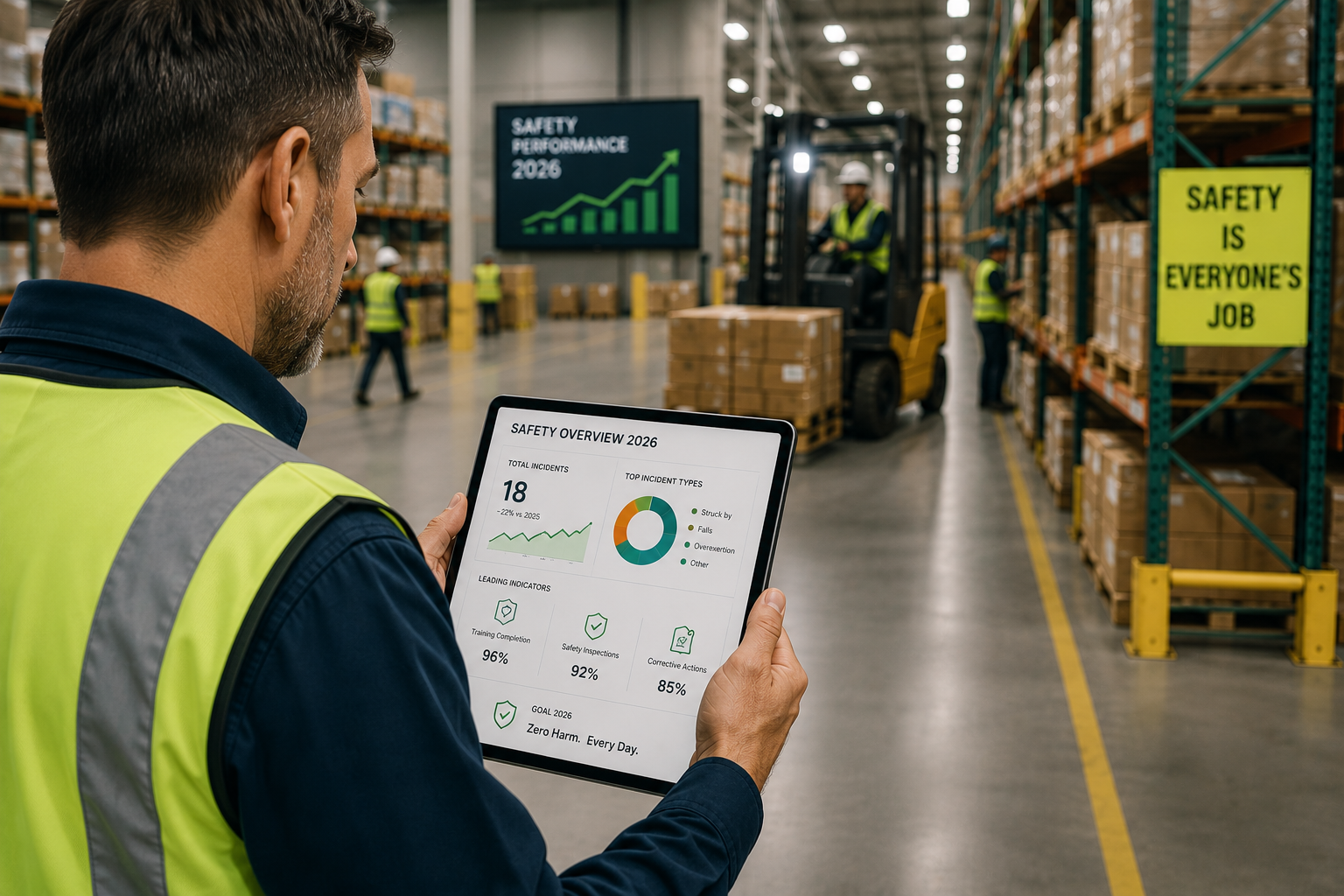
Ask a distribution center manager what they are measured on.
Throughput.
On-time shipment.
Labor productivity.
Inventory accuracy.
Cost per unit.
Customer performance.
Downtime.
Then ask who owns safety.
The answer is often different.
The EHS manager.
The safety team.
The regional safety director.
Perhaps HR.
This division of responsibility has existed for decades.
It is also becoming increasingly difficult to maintain in modern distribution centers.
Some of the most important conditions influencing workplace injuries are created long before a safety team investigates an incident.
A labor decision changes work intensity.
A layout decision changes worker movement.
A slotting decision changes handling frequency.
A productivity project changes repetition.
A maintenance delay changes how employees interact with equipment.
A new customer changes the products workers handle.
An automation project redesigns human work.
These are operational decisions.
They can also influence physical workplace risk.
For distribution center managers in 2026, this creates an important management responsibility.
Safety cannot operate separately from the decisions that shape daily work.
The objective remains clear: prevent injuries, reduce lost-time incidents, and protect workforce availability.
The question is how organizations can identify and reduce meaningful risk early enough to achieve those outcomes.
Injury rates remain one of the most important measures of safety outcomes.
For companies investing in injury prevention, the ultimate objective is clear.
Fewer employees getting hurt.
Fewer lost-time injuries.
Less absence caused by preventable physical risk.
More employees completing physically demanding work without injury.
The limitation is not the injury rate itself.
The limitation is timing.
Injury rates confirm whether harm has already occurred. They are less effective at showing where physical risk may be developing before an injury becomes part of the data.
Consider a distribution center with strong injury performance.
During the same period, the product mix changes.
Overtime increases.
A high-volume picking area handles more cycles.
A temporary workstation remains in use.
Employees develop a workaround around unavailable equipment.
None of these changes automatically causes an injury.
But each can change the conditions under which work is performed.
The injury rate may remain low.
That is a positive outcome.
The organization should protect it.
The stronger prevention question is:
What can we identify and change today that may help keep injury rates low tomorrow?
This is where earlier indicators of physical exposure become valuable.
Injury outcomes and exposure information should not compete.
They serve different moments in the prevention process.
Physical exposure data can help organizations identify where demanding work may deserve investigation.
Ergonomic interventions can reduce or redesign that exposure.
Injury rates, lost-time injuries, absence, and other workforce outcomes can then help organizations evaluate whether prevention efforts are producing meaningful results.
The objective is not to replace injury metrics.
It is to give safety and operations teams more opportunities to act before an injury occurs.
Modern distribution centers combine multiple categories of workplace risk.
Powered industrial trucks.
Material handling.
Ergonomic exposure.
Slips, trips, and falls.
Loading and unloading.
Pedestrian-equipment interaction.
Automation.
Robotics.
In some facilities, hazardous materials and specialized processes.
Organizations usually assign these topics to different functions.
Forklift safety may sit with EHS.
Automation with engineering.
Productivity with operations.
Staffing with HR.
Equipment reliability with maintenance.
Ergonomics may involve safety, occupational health, or a specialist team.
The employee experiences all of these systems together.
A warehouse worker does not separate a task into an operational component and an ergonomic component.
The worker interacts with the complete work environment.
This is why distribution center managers have an important role in injury prevention.
Not because they should replace safety specialists.
They should not.
EHS professionals and ergonomists provide expertise that operational managers cannot be expected to replicate.
But operations creates many of the conditions specialists are trying to improve.
A storage decision influences reach.
A staffing decision can influence task distribution.
A maintenance delay may create a temporary manual process.
A throughput improvement can change handling frequency.
A layout redesign changes movement.
Safety expertise becomes more effective when it is connected to operational decision-making.
For distribution center managers, the question is therefore not:
How do I take ownership away from EHS?
It is:
How do I make sure operational decisions support our injury-prevention objectives?
Distribution centers are designed to improve.
Reduce travel.
Increase picks per hour.
Improve cube utilization.
Reduce unnecessary touches.
Optimize labor.
Automate transport.
Improve material flow.
These projects are necessary for competitive logistics operations.
They can also improve safety.
A redesigned workstation may reduce reaching.
Automation may remove manual transport.
Better slotting may reduce difficult handling.
A mechanical aid may reduce physical force.
Productivity and ergonomics are not natural opponents.
In well-designed operations, they can improve together.
But every significant operational improvement should trigger one simple question:
What does the employee physically do differently after this change?
Consider a slotting optimization.
Fast-moving products are moved closer to the picking area.
Walking decreases.
Productivity improves.
That may reduce physical demand.
But employees may now handle specific products more frequently within a smaller area.
Repetition may change.
The overall ergonomic result cannot be understood through travel distance alone.
Or consider automation.
A robot removes repeated product transport.
Employees no longer walk long distances carrying or pushing material.
This may represent a major ergonomic improvement.
But the employee may now perform a different task at a fixed workstation.
The correct question is not whether automation is good or bad for ergonomics.
It is how physical exposure changed.
What increased?
What decreased?
What became less demanding?
What became more frequent?
Which movement disappeared?
Which movement replaced it?
This is the connection distribution center managers should expect between productivity projects and injury prevention.
Operational improvements should improve the system.
Understanding human work helps verify that they do.
Corporate organizations depend on job categories.
Picker.
Packer.
Loader.
Material handler.
Warehouse associate.
These classifications are necessary for workforce planning and management.
They are less useful for understanding physical exposure.
Two employees classified as order pickers may perform fundamentally different physical work.
One handles lightweight products between waist and shoulder height.
Another retrieves irregular products from low storage locations.
One walks long distances between picks.
Another remains in a compact picking zone.
One experiences varied work.
Another performs a narrow movement pattern at high frequency.
The employees share a job title.
Their physical exposure may differ significantly.
This matters especially in multi-site organizations.
Two distribution centers may use the same process name.
The same standard operating procedure.
The same warehouse management system.
The same job classifications.
Yet small operational differences can change physical work.
Shelf height.
SKU profile.
Product velocity.
Equipment.
Layout.
Work frequency.
Local processes.
This is why physical exposure should be understood where work is actually performed.
The objective is not to create a different safety strategy for every employee.
It is to identify where apparently comparable work creates meaningfully different physical demands.
If one site has consistently reduced injury risk in a process while another continues to experience musculoskeletal injuries, the difference deserves investigation.
The answer may exist in the work itself.
Warehouse automation has significant injury-prevention potential.
Autonomous mobile robots can reduce manual transport.
Automated storage and retrieval systems can change how employees access inventory.
Mechanical systems can remove heavy or repetitive material-handling tasks.
Robotic technologies can remove workers from hazardous environments.
Digital systems can improve process visibility.
These are meaningful opportunities.
The International Labour Organization has highlighted the potential of automation, advanced robotics, artificial intelligence, and smart monitoring systems to reduce hazardous exposure and support occupational injury prevention.
But the safety value of automation should be evaluated through the redesigned process.
A robot removes a transport task.
What does the worker do instead?
An automated storage system brings inventory to a workstation.
How frequently does the employee now handle products?
A conveyor eliminates carrying.
How does it change work pace?
A digital system optimizes task sequences.
How does the new sequence influence physical demand?
These questions do not challenge the value of automation.
They help organizations realize its full safety value.
The strongest automation project is not simply one that removes an old hazard.
It is one that creates better work.
For distribution center managers, post-implementation reviews should therefore include both operational and human outcomes.
Did throughput improve?
Did quality improve?
Did downtime change?
Did physical exposure decrease?
Were high-risk movements reduced?
Did employees report improved work conditions?
Did injury outcomes improve over time?
If automation is introduced partly to improve safety, organizations should be able to evaluate whether it achieved that objective.
Every distribution center has workarounds.
Employees use a different cart because the preferred equipment is unavailable.
Products are temporarily stored in another location.
A packing station is modified.
A manual process replaces an automated step.
Workers develop a faster method for completing a task.
Some workarounds create obvious safety concerns.
Others appear harmless.
But repeated workarounds are valuable management information.
If one employee ignores a process, the issue may be individual.
If an entire shift independently develops the same alternative method, the process deserves attention.
Why does the workaround exist?
Is the documented process difficult to follow?
Is equipment unavailable?
Does the standard method require unnecessary physical effort?
Does the process fail under peak volume?
Is the layout creating an avoidable movement?
Workers are highly adaptable.
This adaptability helps warehouses operate under changing conditions.
But it can also hide physical demands.
If a workstation is poorly positioned, employees change posture.
If a product is difficult to grip, they change handling strategy.
If a cart requires more force, workers may use body weight.
If a process creates unnecessary movement, experienced employees find shortcuts.
The operation continues.
The target is achieved.
The physical compensation may remain invisible.
For injury prevention, this creates an opportunity.
Do not investigate only whether employees follow the process.
Investigate why experienced employees repeatedly change it.
A workaround may identify a process that can be redesigned before physical exposure contributes to an injury.
Modern distribution centers are data-rich environments.
Managers can see order volume.
Pick rates.
Labor hours.
Equipment utilization.
Inventory movement.
Downtime.
Quality.
Absence.
Overtime.
The physical exposure required to produce those outcomes is often less visible.
Consider two shifts.
Both achieve the same throughput.
Both use the same number of employees.
Both meet quality targets.
Operationally, performance appears identical.
But one shift may handle a different product mix.
Employees may complete more low-level picks.
A workstation may require more reaching.
One process may involve higher handling frequency.
The operational dashboard may not show the difference.
Yet understanding these differences can support injury prevention.
Physical exposure information helps organizations answer practical questions.
Where is physically demanding work concentrated?
Which tasks deserve a deeper ergonomic assessment?
How does exposure differ between sites?
Did a workstation redesign reduce the targeted physical demand?
Did automation remove the movement it was intended to remove?
Which intervention should be prioritized first?
For WearHealth, this is where data-driven ergonomics becomes relevant.
The objective is not to monitor every movement for its own sake.
It is to identify meaningful patterns in physical work early enough to support intervention.
The prevention logic is straightforward:
Identify physical exposure earlier. Prioritize meaningful risks. Improve work. Evaluate the intervention. Measure success through better safety and workforce outcomes.
Ultimately, the goal remains fewer injuries.
Exposure visibility helps organizations act earlier in pursuit of that goal.
Artificial intelligence has become one of the most frequently used terms in industrial technology.
AI safety monitoring.
AI risk detection.
AI video analysis.
Predictive safety.
Automated ergonomic assessment.
The technology can be valuable.
But more detection does not automatically mean better prevention.
A distribution center contains thousands of movements and operational interactions every hour.
A system that generates an alert for every theoretical deviation can quickly create more information than a safety team can use.
The purpose of AI should not be to produce the largest number of warnings.
It should help organizations identify where action may have the greatest injury-prevention value.
Which work area deserves investigation?
Which physical exposure occurs frequently?
Which process differs between sites?
Where did a recent change alter worker movement?
Did an intervention reduce targeted exposure?
Where should an ergonomist focus limited assessment time?
These are practical prevention questions.
AI and digital ergonomic technologies become valuable when they help safety and operations teams prioritize.
For distribution center managers evaluating technology in 2026, one question is particularly useful:
What injury-prevention decision will we make differently because we have this information?
If the answer is clear, the technology may support action.
If the answer is unclear, the organization may simply be creating another dashboard.
As warehouses introduce wearables, computer vision, AI systems, and digital worker technologies, data governance becomes a leadership issue.
This is particularly important in Europe.
Technology can provide valuable information about work.
It can also create understandable questions among employees.
What is measured?
Why is it measured?
Who can see the information?
Is the system evaluating workplace exposure or individual performance?
How long is information stored?
Can the data influence employment decisions?
Managers should not treat these questions as resistance to injury prevention.
They are part of responsible implementation.
A technically effective ergonomic system can fail if employees do not trust how information is used.
This is especially relevant for movement and physical exposure data.
The purpose should be clear.
Understand workplace exposure.
Identify physical risk patterns.
Evaluate work design.
Prioritize ergonomic intervention.
Support injury prevention.
The closer a technology comes to the worker, the more important transparency becomes.
In 2026, responsible implementation is part of safety technology performance.
Distribution center managers should therefore involve EHS, ergonomics, employee representatives, data protection teams, and operations early.
Not after deployment.
Before the technology becomes part of daily work.
Distribution centers have structured processes for serious incidents.
An injury is reported.
The area is reviewed.
Management is informed.
An investigation begins.
Corrective actions are assigned.
The trigger is clear.
An employee was hurt.
Operational change rarely creates the same response.
A new customer is added.
Products are relocated.
A productivity project changes cycle frequency.
Temporary labor increases.
A workstation is redesigned.
A temporary process remains in use.
The warehouse changes.
Injury performance may remain strong.
The objective should be to protect that performance by understanding whether the work has changed in a meaningful way.
NIOSH's Prevention through Design approach emphasizes eliminating or minimizing occupational hazards and risks during the design and redesign of workplaces, tools, equipment, machinery, and work processes.
For distribution center managers, the practical interpretation is simple.
Safety needs operational triggers.
Not every warehouse change requires a complete ergonomic assessment.
That would be unrealistic.
But significant changes should create a question.
Did physical work change?
Did handling frequency change?
Did equipment interaction change?
Did the layout change?
Did employees begin using a new movement strategy?
Did the workforce change?
If the answer is yes, the operation may deserve review.
The goal is not to predict every injury.
It is to create more opportunities to prevent one.
A distribution center manager does not need to know every ergonomic assessment method.
They do not need to calculate a lifting index.
They do not need to replace the EHS team.
But they should be able to answer ten questions.
What changed in our operation during the last six months?
Which productivity projects changed human work?
Where are temporary processes still active?
Which tasks generate the most physical demands?
Where do employees repeatedly use workarounds?
Which physical tasks differ between shifts or work areas?
How has automation changed human work?
Which information helps us identify physical risk before an injury?
What worker data is collected, and why?
When did physical exposure information last change an operational decision?
The final question may be the most revealing.
Many organizations collect safety information.
Fewer can identify a recent operational decision that changed because physical exposure data revealed an opportunity for injury prevention.
This is the difference between collecting safety information and using it.
Distribution center managers already understand response time.
How quickly is a system problem detected?
How quickly does maintenance respond?
How quickly can labor be reallocated?
How quickly can inventory be redirected?
Injury prevention has a similar challenge.
How much time passes between identifying meaningful physical exposure and taking action?
We call this prevention response time.
Prevention response time is the period between identifying a meaningful physical risk condition and the organization's decision to investigate, control, or redesign the work.
An injury often creates an immediate response.
The event is serious.
Management acts.
Physical exposure can create a slower response.
A repetitive task changes gradually.
Employees adapt.
The condition becomes normal.
Discomfort may appear.
Absence may increase.
An injury may eventually occur.
The objective of proactive injury prevention is to shorten this timeline.
Identify meaningful exposure earlier.
Investigate sooner.
Prioritize interventions.
Evaluate whether physical exposure decreases.
Track whether injury and workforce outcomes improve.
Better reporting can help.
Employee engagement can help.
Professional ergonomic assessment can help.
Operational triggers can help.
Data-driven exposure analysis can help.
The management objective is the same.
Create more opportunities to reduce risk before an employee is injured.
Safety leadership is often described through visible behavior.
Attend safety meetings.
Talk to employees.
Follow PPE requirements.
Participate in investigations.
These actions matter.
But operational safety leadership goes further.
It means recognizing that management decisions shape physical work.
A productivity target can change frequency.
A storage decision can change posture.
A staffing decision can change task distribution.
A maintenance decision can create a workaround.
An automation decision can redesign human-machine interaction.
A customer decision can change material handling.
The EHS team can advise.
Ergonomists can assess.
Engineers can redesign.
Technology can provide information.
Distribution center managers connect these decisions inside the operation.
That is why injury prevention increasingly belongs in operational leadership.
Not because managers should become safety specialists.
Because operational decisions can create opportunities to reduce physical risk.
The objective of workplace injury prevention is not complicated.
Fewer employees getting hurt.
Fewer lost-time injuries.
Less injury-related absence.
Better protection for people performing physically demanding work.
Injury rates remain essential because they show whether organizations are achieving those outcomes.
But companies do not have to wait for injury data to begin improving work.
Physical exposure can be investigated earlier.
High-demand tasks can be identified.
Workstations can be redesigned.
Operational changes can be reviewed.
Ergonomic interventions can be evaluated.
Technology can help organizations understand physical work at greater scale.
This is where the next opportunity in distribution center safety exists.
Not replacing injury metrics.
Connecting prevention activity more directly to injury outcomes.
The management logic is simple:
See meaningful physical risk earlier.
Act on it sooner.
Reduce exposure where possible.
Evaluate whether the intervention worked.
Measure success through fewer injuries and better workforce outcomes.
For distribution center managers in 2026, safety is increasingly an operational question because the decisions that shape work also shape opportunities for injury prevention.
The ultimate measure of success remains the same.
More employees going home healthy.
Fewer injuries.
And a distribution center designed to keep it that way.
Distribution centers can reduce workplace injuries by combining injury data with earlier physical risk identification, ergonomic assessment, employee input, work design improvements, and evaluation of whether interventions reduce physical exposure and improve injury outcomes.
Injury rates are important because they measure safety outcomes and help organizations evaluate whether employees are being injured at work. Earlier physical exposure information can complement injury rates by helping teams identify and address potential risk before an injury occurs.
Ergonomic data can help organizations identify physically demanding tasks, compare exposure between work areas, prioritize assessments, evaluate interventions, and understand whether changes in work design reduce targeted physical risk.
AI can support injury prevention by helping organizations analyze physical work at scale, identify patterns in exposure, and prioritize tasks for investigation. Its value depends on whether the information leads to effective ergonomic or operational interventions.
Managers should consider whether the change affects physical work, handling frequency, worker movement, equipment interaction, or task distribution. Meaningful changes may justify an ergonomic or physical exposure review to identify opportunities for injury prevention.
To explore decades of research on warehouse safety and ergonomics, read “What More Than 30 Years of Warehouse Safety Research Tells Us.”
To understand why apparently identical jobs can create different physical demands, read “The Same Job, a Different Physical Workload: Why Warehouse Risk Varies Between Sites.”
Occupational Safety and Health Administration. Leading Indicators.
Occupational Safety and Health Administration. Warehousing.
National Institute for Occupational Safety and Health. Prevention through Design.
National Institute for Occupational Safety and Health. Ergonomics and Work-Related Musculoskeletal Disorders.
International Labour Organization. Revolutionizing Health and Safety: The Role of AI and Digitalization at Work.
European Agency for Safety and Health at Work. Digitalisation of Work.
European Agency for Safety and Health at Work. Musculoskeletal Disorders.
International Ergonomics Association. Human Factors and Ergonomics.
mehr Einblicke

October 16, 2026
HSE teams cannot address every ergonomic risk at once. Discover four factors that help managers set priorities and make better-informed workplace safety decisions.
August 18, 2026
How can warehouse managers determine whether an ergonomics tool will work in their operation? Learn how to evaluate solutions through real-world pilots, usability, workflow integration and privacy.
