


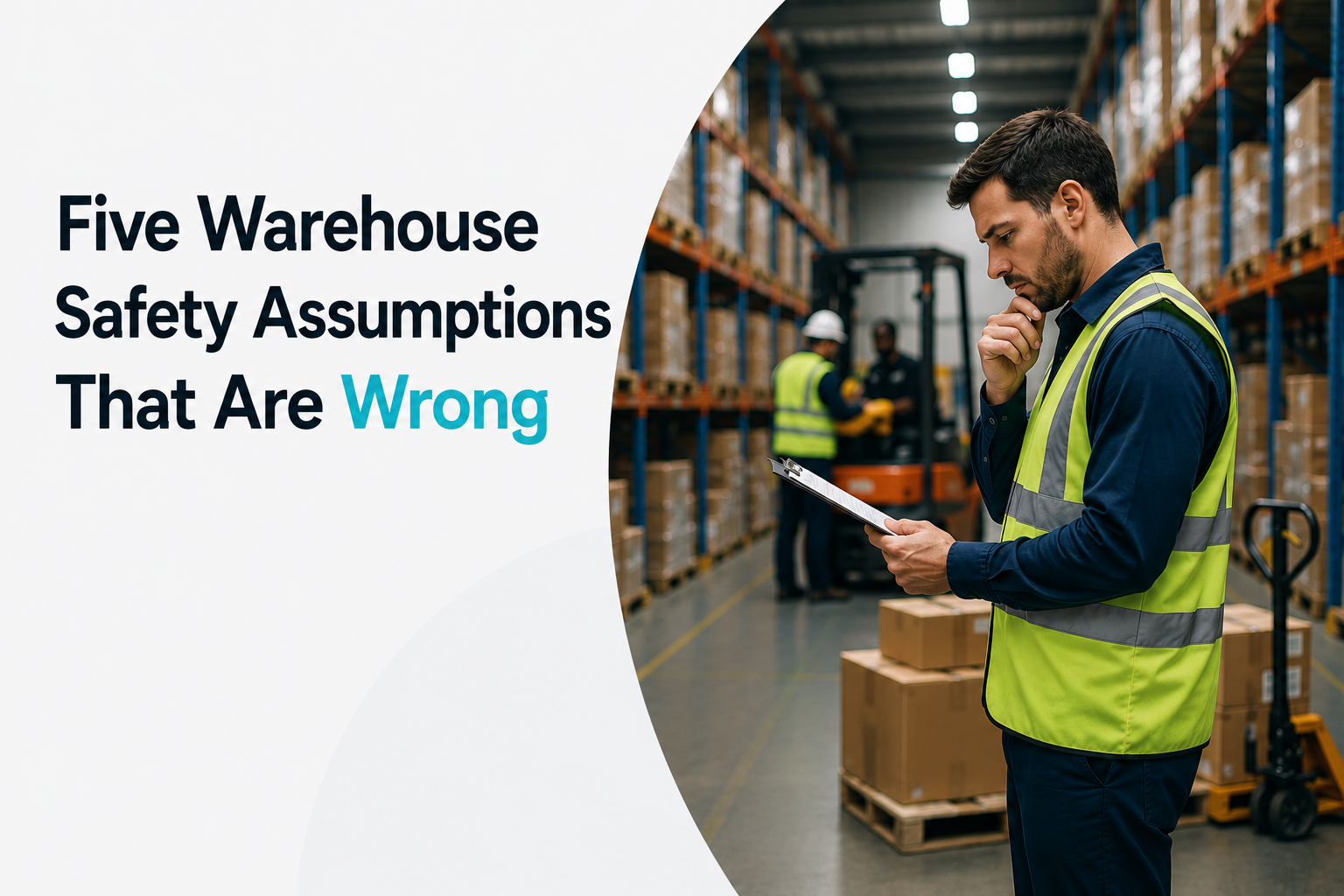
Most distribution centers do not ignore safety.
They invest in personal protective equipment. They conduct inspections. They train employees. They track injuries. They introduce reporting systems and review incidents.
Yet serious workplace injuries continue to occur.
The immediate explanation is often that someone failed to follow a procedure.
An employee took a shortcut.
A supervisor missed a hazard.
A safety rule was ignored.
Sometimes that explanation is correct.
But it can also prevent leaders from asking a more difficult question:
What if the safety system is working exactly as it was designed—and the design itself is incomplete?
Many warehouse safety programs are built around assumptions that appear reasonable. They have been repeated so frequently that they are rarely challenged.
PPE protects workers.
Inspections identify unsafe conditions.
Employees report hazards.
Low injury rates indicate strong safety performance.
Training improves unsafe behavior.
Each assumption contains some truth.
The problem begins when a useful safety practice becomes a substitute for understanding how risk actually develops inside a distribution center.
For warehouse leaders, the challenge is not to abandon established safety practices.
It is to recognize what those practices cannot tell them.
Walk through almost any modern distribution center and safety is immediately visible.
High-visibility clothing.
Safety footwear.
Gloves.
Protective eyewear.
Hearing protection.
In some environments, helmets and additional task-specific protective equipment.
The visibility of PPE makes it psychologically powerful.
Leaders can see compliance.
A worker is either wearing the required equipment or not.
This creates a simple management metric.
But PPE answers a very specific question:
How can we reduce harm when a worker is exposed to a hazard?
It does not necessarily answer the more important question:
Why does the exposure exist?
Consider pedestrian interaction with powered industrial trucks.
A high-visibility vest may improve visibility.
But it does not change an intersection where pedestrians and forklifts repeatedly cross the same route.
Safety shoes can reduce the consequences of certain material-handling incidents.
They do not change how products are stacked.
Gloves can protect the hands.
They do not redesign packaging that requires excessive grip force or repeated difficult handling.
The hierarchy of controls used in occupational safety reflects this distinction. The National Institute for Occupational Safety and Health places elimination, substitution and engineering controls above administrative controls and personal protective equipment because controls that reduce exposure at the source are generally more effective.
The management problem is subtle.
PPE can create the appearance of safety improvement without changing the process that creates risk.
This does not make PPE unimportant.
It makes PPE incomplete.
The leadership question should therefore move beyond compliance.
Not simply:
Are employees wearing the correct equipment?
But:
Which hazards have we accepted as permanent because PPE makes them appear manageable?
That question is much harder to answer.
It is also much more valuable.
Inspections are one of the foundations of occupational safety.
They create structure.
They identify visible hazards.
They establish accountability.
They document compliance.
But an inspection has an unavoidable limitation.
It captures a moment.
A distribution center is a system in motion.
Inventory changes.
Employees rotate.
Temporary workers arrive.
Equipment becomes unavailable.
Maintenance issues develop.
Order volume increases.
Layouts are modified.
Products are temporarily stored in unusual locations.
A process that was safe during an inspection may operate differently three weeks later.
The difference is particularly important in logistics because operational adaptation is considered a strength.
Warehouse teams solve problems quickly.
A conveyor stops working.
The team creates a temporary process.
A staging area reaches capacity.
Products are moved elsewhere.
Equipment is unavailable.
Another method is used.
A large order arrives.
Labor is reassigned.
The operation continues.
From a customer perspective, this is resilience.
From a safety perspective, every adaptation can change exposure.
The question is not whether employees should adapt.
Industrial operations could not function without local problem-solving.
The question is whether the safety system can see operational changes as quickly as the operation creates them.
Traditional inspections often struggle with this.
An audit may confirm that the documented process is controlled.
The real process may already have changed.
This creates what could be called the inspection lag: the period between a change in operational conditions and the organization's recognition that the risk profile has also changed.
The faster the operation changes, the more important this lag becomes.
A warehouse should therefore not interpret a successful inspection as evidence that the facility is safe.
It is evidence that specific conditions were evaluated at a specific point in time.
The more strategic question is:
How quickly can we identify risk when the operation changes between inspections?
Most organizations encourage employees to speak up.
Report unsafe conditions.
Submit near misses.
Tell a supervisor.
Use the digital reporting system.
The assumption is that significant hazards will eventually become visible because employees closest to the work will report them.
Sometimes they do.
But reporting is not simply a communication process.
It is a judgment.
Every time an employee identifies a potential hazard, the employee makes a decision.
Is this serious enough to report?
Has someone already reported it?
Will anything happen?
Will reporting slow the shift?
Will my supervisor be frustrated?
Am I overreacting?
Is this simply how the job works?
These questions influence whether information enters the safety system.
The most important risk may therefore not be the hazard employees refuse to report.
It may be the hazard employees no longer recognize as unusual.
Consider a worker who must repeatedly reach around a conveyor to handle products.
The first day, the movement feels awkward.
After six months, it is simply the job.
Or consider a damaged cart that requires additional pushing force.
Employees adapt.
They lean differently.
They ask a colleague for help.
They select another cart when one is available.
The problem becomes part of the operating environment.
Nobody submits a report.
Not because the condition is safe.
Because it is normal.
This is one of the fundamental limitations of reporting systems.
They are good at capturing events employees recognize as reportable.
They are less effective at identifying normalized exposure.
For WearHealth and industrial ergonomics, this distinction is particularly important.
Physical risk often develops inside routine work.
Repetitive movement.
Awkward reaching.
Frequent bending.
Sustained physical demand.
These conditions may not feel like incidents.
They may never generate a near-miss report.
Yet NIOSH and other occupational health authorities recognize force, repetition and awkward posture as relevant risk factors for work-related musculoskeletal disorders.
The management implication is clear.
Employee reporting is essential.
But organizations cannot outsource risk detection entirely to employees.
Leaders must ask:
Which risks have become so normal that nobody thinks to report them anymore?
Few metrics are as influential in safety management as injury rates.
Recordable injuries.
Lost-time incidents.
Days away from work.
TRIR.
DART.
These metrics matter.
They allow organizations to identify trends, compare performance and understand previous outcomes.
The problem is not that companies measure injuries.
The problem is what they infer from the absence of injuries.
Imagine a distribution center that operates for twelve months without a serious recordable injury.
Management concludes that the safety program is effective.
The conclusion feels reasonable.
But consider another possibility.
During the same period, employees repeatedly work around damaged equipment.
Near-miss reporting declines.
Overtime increases.
Corrective actions remain open longer.
A new product category creates more demanding manual handling.
A temporary layout introduces pedestrian congestion.
None of these conditions produces an injury.
Yet.
The injury rate remains excellent.
This illustrates a basic problem with outcome metrics.
An outcome tells us what happened.
It does not necessarily describe the conditions that currently exist.
The distinction is familiar in other areas of business.
A company can report strong quarterly revenue while customer satisfaction is deteriorating.
A manufacturing line can meet production targets while maintenance backlogs grow.
A warehouse can achieve on-time delivery while overtime becomes structurally necessary.
Leaders understand that performance outcomes can temporarily remain positive while underlying conditions weaken.
Safety should be treated with the same analytical discipline.
A low injury rate is a positive outcome.
It is not proof that risk is low.
The stronger management question is:
What conditions would we expect to see before injury performance begins to deteriorate?
That shifts attention from injury counting to risk visibility.
When an employee performs a task unsafely, training is one of the most common organizational responses.
The logic is straightforward.
The employee behaved incorrectly.
The correct method is explained.
The employee is retrained.
The corrective action is documented.
The case is closed.
But what if the employee already knew the correct method?
This possibility deserves more attention.
Imagine a warehouse employee repeatedly twists while transferring products from a pallet to a conveyor.
The documented method requires the employee to reposition the feet and face the load directly.
The employee has completed manual handling training.
The procedure is clear.
Yet the twisting continues.
The traditional explanation is behavioral.
The employee is taking a shortcut.
But an operational investigation may reveal something different.
The conveyor moves quickly.
The pallet is positioned poorly.
Repositioning for every item increases cycle time.
The employee has discovered the fastest way to meet the expected pace of work.
The behavior is unsafe.
But it is not irrational.
The work system is rewarding it.
This is where training-based safety interventions often fail.
They assume the employee does not know the correct behavior.
In reality, the employee may understand the rule perfectly and operate inside a system where following it creates another problem.
Lower productivity.
More physical effort.
Process delays.
Supervisor attention.
Training cannot resolve a conflict between the documented process and the practical demands of work.
Only work design can.
This does not mean unsafe behavior should be accepted.
It means behavior should be investigated before it is corrected.
When multiple employees independently develop the same unsafe shortcut, leaders should be cautious about describing the problem as individual behavior.
Repeated behavior is often system information.
The better question is:
What makes the unsafe method easier, faster or more practical than the safe method?
The answer may reveal more than another training session ever could.
PPE.
Inspections.
Reporting.
Injury rates.
Training.
These are not bad safety practices.
Every credible warehouse safety program will use most or all of them.
The problem is that each practice measures or controls a visible part of the safety system.
PPE is visible.
Inspection findings are documented.
Reports can be counted.
Injury rates can be compared.
Training completion can be measured.
What remains less visible is the interaction between work and risk.
How does a layout change alter physical exposure?
What happens when productivity pressure increases?
Which workarounds have become normal?
Where does the documented process conflict with operational reality?
Which repetitive physical demands never generate an incident report?
What changes between an annual assessment and peak season?
These questions are difficult because the answers are distributed throughout daily operations.
There is rarely one dramatic failure.
Instead, risk develops through small operational conditions.
This is why warehouse safety is increasingly a visibility problem.
Organizations often have more safety data than ever.
The challenge is whether that data describes the reality of work.
Many companies measure the activity of their safety programs.
Number of inspections.
Number of training sessions.
Number of observations.
Number of corrective actions.
Number of reports.
These metrics answer an important question:
Are we doing the things our safety system requires?
But leaders also need to ask:
Are those activities improving our understanding of risk?
An inspection that repeatedly identifies the same issue may be active but ineffective.
A reporting system that receives hundreds of reports without revealing patterns may generate data without insight.
A training program may achieve 100 percent completion while employees continue developing the same workarounds.
A low injury rate may coexist with deteriorating operational conditions.
The next generation of warehouse safety management will require organizations to distinguish between safety activity and risk understanding.
The first is relatively easy to measure.
The second requires context.
Physical workplace risk illustrates the problem particularly well.
Many physical demands do not look like traditional safety incidents.
An employee bends.
Reaches.
Pushes.
Pulls.
Carries.
Repeats.
The task is completed.
No alarm sounds.
No machine stops.
No near miss is submitted.
The work continues.
This makes physical exposure easy to normalize.
A process may operate for years before an organization recognizes that employees in one work area experience significantly greater physical demands than employees performing apparently similar jobs elsewhere.
This is why ergonomic risk assessment increasingly needs to move beyond isolated observations.
The relevant question is not simply whether a worker performed an awkward movement.
It is how physical exposure is distributed across real work.
How frequently does the movement occur?
How long does the exposure continue?
Which tasks create the greatest physical demand?
How does the exposure change between sites, shifts or product categories?
These questions connect directly to the wider lesson of the five safety assumptions.
The absence of visible evidence does not prove the absence of risk.
Sometimes the most important safety problem is the one the organization has learned not to see.
Warehouse leaders do not need to abandon PPE, inspections, reporting, injury metrics or training.
They need to stop allowing these practices to end the investigation.
When PPE compliance is high, ask which underlying hazards remain.
When an inspection is successful, ask what has changed since the inspection.
When hazard reporting is low, ask whether employees trust the reporting process and whether routine exposure has become normalized.
When injury rates are low, examine the conditions that could influence future outcomes.
When unsafe behavior appears, investigate why the behavior makes sense within the operating environment.
These questions require a different leadership mindset.
The objective is not to prove that the safety program works.
The objective is to continuously test where it might be wrong.
Bad safety decisions are easy to criticize in hindsight.
The more difficult challenge is recognizing reasonable decisions built on incomplete assumptions.
PPE does protect workers.
Inspections do identify hazards.
Employees do report concerns.
Low injury rates are positive.
Training does influence behavior.
All five statements are true.
They are simply not complete.
Warehouse safety becomes stronger when leaders recognize the limits of their own systems.
When they look beyond visible compliance.
When they investigate silence.
When they question positive metrics.
When they treat repeated behavior as information.
And when they ask whether safety processes describe how work is actually performed.
The safest distribution centers may not be the facilities with the most rules, the most inspections or the most sophisticated dashboards.
They may simply be the organizations most willing to challenge what they think they already know.
Common warehouse safety assumptions include believing that PPE makes work safe, passing an inspection proves a warehouse is safe, employees will always report important hazards, low injury rates prove safety systems are effective and training alone can correct unsafe behavior.
Injury rates are outcome metrics that describe previous incidents. A warehouse can have low injury rates while operational risk factors such as unresolved hazards, changing physical exposure, equipment problems or unsafe workarounds are developing.
Warehouse operations change frequently because of product mix, staffing, layouts, equipment availability and operational pressure. Continuous risk assessment helps organizations identify how these changes influence workplace risk between formal inspections.
For a broader management perspective, read “Safety Management for Distribution Centers: Why Some Warehouses Consistently Outperform Others.”
To understand why identical warehouse jobs can create different physical demands, continue with “The Same Job, a Different Physical Workload: Why Warehouse Risk Varies Between Sites.”
For the wider business impact of workplace incidents, read “The Hidden Costs of Workplace Injuries: What Safety Reports Often Miss.”
National Institute for Occupational Safety and Health. Hierarchy of Controls.
Occupational Safety and Health Administration. Warehousing.
National Institute for Occupational Safety and Health. Ergonomic Risk Factors.
Health and Safety Executive. Consulting Employees on Health and Safety.
European Agency for Safety and Health at Work. Worker Participation in Occupational Safety and Health.
Reason, J. Managing the Risks of Organizational Accidents. Ashgate, 1997.
More Insights
October 16, 2026
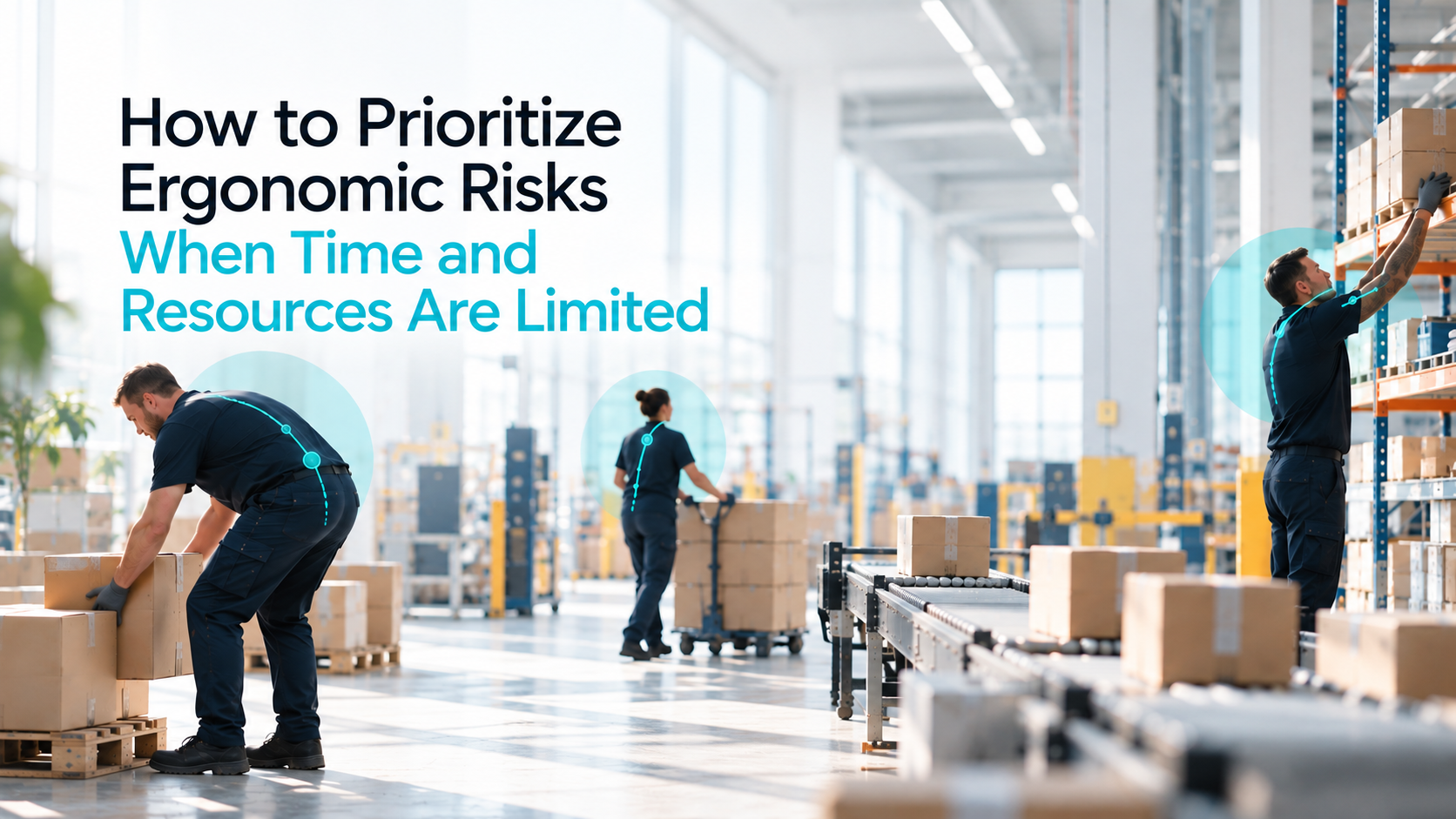
HSE teams cannot address every ergonomic risk at once. Discover four factors that help managers set priorities and make better-informed workplace safety decisions.
August 18, 2026
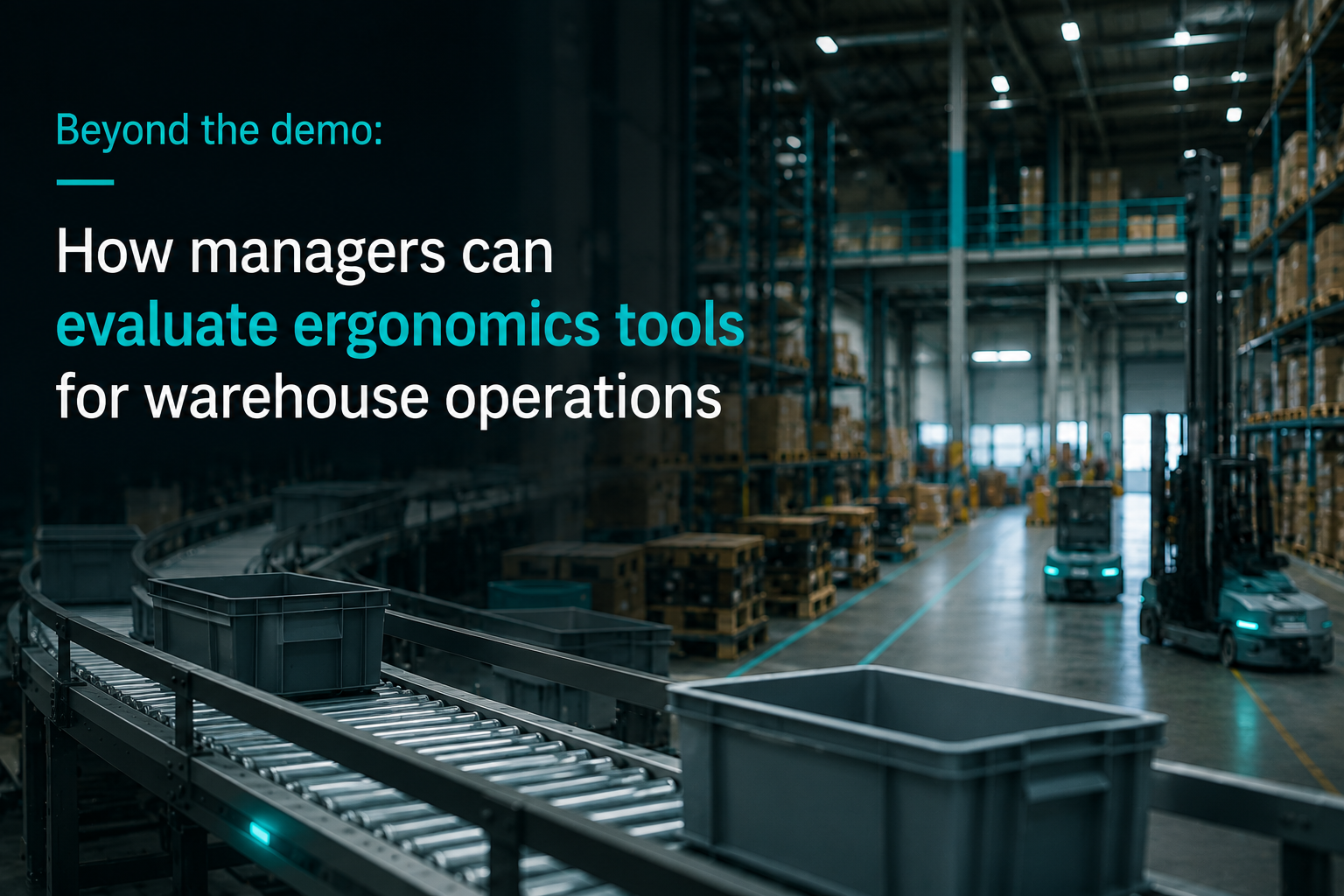
How can warehouse managers determine whether an ergonomics tool will work in their operation? Learn how to evaluate solutions through real-world pilots, usability, workflow integration and privacy.
