


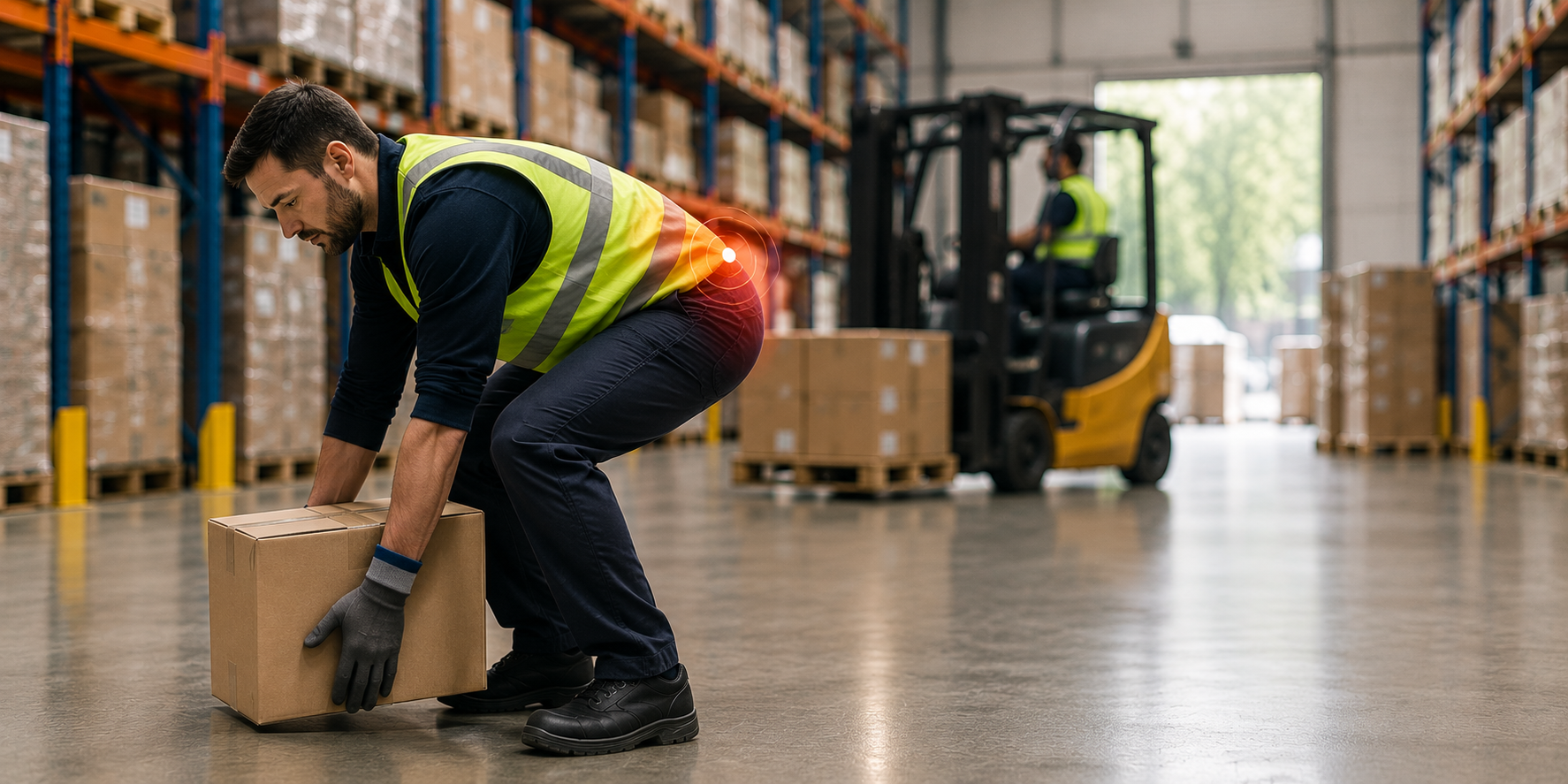
Most warehouse lifting problems are addressed with the same familiar measures.
Lifting training. Safety reminders.Posters.Incident reviews. A renewed instruction to “lift correctly.”
These measures can be useful. But they share one limitation.
They often assume that every lifting problem has the same solution. It does not.
A heavy load is a different problem from a deep pallet.
A difficult-to-grip package is a different problem from repeated trunk twisting.
A task performed 20 times per shift is different from the same task performed 800 times.
A lifting aid that employees regularly bypass creates a different prevention challenge from a task where no lifting assistance exists at all.
Organizations trying to prevent lifting injuries in warehouse operations should therefore begin with a more practical question:
What exactly makes this lifting task physically demanding?
The answer should determine the prevention measure.
If the problem is load weight, reduce the load or provide mechanical assistance.
If the problem is reach distance, improve access to the load.
If workers repeatedly bend or twist, examine movement technique and the conditions influencing those movements.
If lifting frequency is high, investigate how physical exposure is distributed across the shift.
If employees cannot grip the product securely, look at packaging and coupling.
The objective is not to introduce more lifting safety measures.
It is to match the right prevention measure to the actual lifting problem.
Warehouse safety programs often begin with available solutions.
We have a training program.
We have a lift-assist device.
We have job rotation.
We have an ergonomic assessment checklist.
The natural tendency is to apply these measures to the next lifting concern.
A better approach begins with diagnosis.
Consider three warehouse employees who all report that a lifting task is physically demanding.
The first employee handles a 25-kilogram load.
The second handles a much lighter product but must reach across a deep pallet.
The third handles a moderate load several hundred times during a shift.
All three employees are performing manual lifting.
But the physical problem is different.
Giving all three employees the same lifting training may improve general awareness.
It does not necessarily address the main source of physical demand in each task.
The first task may require mechanical assistance or a reduction in load weight.
The second may require better pallet access.
The third may require a closer analysis of lifting frequency, task duration, and work organization.
This distinction is fundamental when companies want to prevent lifting injuries in warehouse environments.
Do not ask only:
What lifting safety measure should we introduce?
Ask:
Which characteristic of this lifting task are we trying to change?
Heavy loads are the most obvious manual handling concern.
But even here, weight should not be considered in isolation.
The Revised NIOSH Lifting Equation demonstrates why.
For suitable two-handed lifting tasks, the equation considers factors including horizontal distance, vertical position, lifting frequency, asymmetry, and coupling quality when calculating a Recommended Weight Limit.
Under ideal lifting conditions, the equation begins with a load constant of 23 kilograms, or approximately 51 pounds.
This is not a universal safe lifting limit.
Real warehouse lifting conditions are rarely ideal.
The load may begin close to the floor.
The worker may need to reach forward.
The lift may repeat frequently.
The product may be difficult to grip.
The employee may need to turn toward the destination.
As lifting conditions change, the Recommended Weight Limit calculated for the task can also change.
If load weight is a primary contributor to physical demand, consider reducing the amount handled in one lift.
Can the load be divided into smaller units?
Can packaging be changed?
Can the supplier provide different container sizes?
Can the process use smaller batch quantities?
Where reducing load weight is not practical, mechanical assistance may be appropriate.
Lift tables. Vacuum lifters. Hoists. Manipulators. Pallet positioners. Other lift-assist technologies.
The correct equipment depends on the load and process.
The key is to avoid treating a load-weight problem primarily as a lifting-technique problem.
Proper technique remains important.
But if the lifting conditions exceed what is appropriate for manual handling, the task itself requires intervention.
A warehouse employee may be able to handle a load comfortably when it is close to the body.
Move the same load farther away and the lifting task changes.
Horizontal distance is an important factor in the Revised NIOSH Lifting Equation.
This is particularly relevant during pallet handling.
Imagine an employee depalletizing cases.
The first row is easy to access.
The worker stands close to the load.
As the pallet empties, the remaining cases are located farther away.
The employee begins reaching across the pallet.
The arms extend.
The trunk may move forward.
The same product now creates a different lifting condition.
This problem can easily be missed during a short safety observation.
A manager watches the first five minutes of the task.
Everything looks acceptable.
The most demanding lifting conditions occur later.
If reach distance is the main problem, improve access to the load.
Can the worker move closer to the pallet?
Can the pallet be accessed from more than one side?
Can the pallet be rotated?
Would a turntable improve access?
Could pallet depth be changed?
Would a pallet positioner improve the handling position?
Can the work sequence be modified so employees do not repeatedly reach across remaining products?
Movement technique also matters.
Workers can learn to recognize excessive reaching and reposition themselves where practical.
Feedback can help employees become more aware of repeated high-risk movement patterns.
But if nearly every worker reaches deeply into the same pallet, the pattern deserves a task-level investigation.
Repeated movement can be information about the work.
Floor-level storage is difficult to eliminate from warehouse operations.
Distribution centers have finite space.
Storage density matters.
Not every product can occupy the most accessible rack position.
The problem is not the existence of low storage locations.
The problem is using those locations without considering how frequently products are handled and how employees move when accessing them.
A slow-moving lightweight product stored near floor level creates one type of lifting task.
A high-velocity case handled hundreds of times from the same position creates another.
If low-level lifting is the main concern, start with frequency.
Which products are handled most often?
Which products are heavier?
Which loads require two hands?
Which packages are awkward?
Which low-level positions generate the greatest number of picks?
Use this information during slotting decisions.
Frequently handled or physically demanding products may be better candidates for more accessible storage positions.
Pallet positioners or lift tables may also improve working height in suitable processes.
Lifting technique should be part of the prevention strategy as well.
Employees can learn to recognize excessive trunk flexion and use more favorable movement patterns where the task allows.
The correct intervention depends on the reason low-level lifting occurs.
The answer may be better technique.
Better product placement.
A change in equipment.
Or a combination of measures.
“Do not twist while lifting” is common manual handling advice.
It is useful advice.
Workers can often reduce unnecessary trunk rotation by repositioning their feet and turning the body toward the destination.
But repeated twisting deserves investigation.
Imagine a worker lifting cases from a pallet positioned on the left.
The cases must be placed on a conveyor positioned behind the worker on the right.
The employee performs the movement repeatedly.
In this situation, trunk rotation may not simply be a random behavior.
The work area creates a directional change during every handling cycle.
First, help employees understand how movement technique can influence physical strain.
Can the worker reposition the feet?
Can the body turn toward the destination before the load is placed?
Can the load remain closer to the body during the directional change?
Ergonomic training and feedback can help employees recognize repeated high-risk movement patterns and improve technique.
Then examine the layout.
Can the pallet and conveyor be aligned differently?
Can the worker change position?
Can the destination be moved?
Can material flow be redirected?
Would a turntable reduce the required movement?
The important principle is not to choose between technique and layout automatically.
Ask which intervention addresses the actual problem.
If one worker twists occasionally, coaching may be appropriate.
If almost every worker repeatedly performs the same rotation, investigate the task design.
The heaviest object in a warehouse is easy to identify.
The most frequently lifted object may receive less attention.
This can create a prevention blind spot.
A moderate load handled occasionally creates a different physical exposure pattern from the same load handled several times per minute.
Lifting frequency is therefore an important part of manual handling assessment.
Consider a packing task.
Each product is relatively light.
No individual lift appears remarkable.
But an employee performs the same movement throughout most of the shift.
The question is no longer only whether one lift is demanding.
The frequency and duration of the movement become relevant.
If lifting frequency is the main problem, understand the work pattern.
How many lifts occur per minute or per hour?
How long does the employee remain in the task?
Are there short periods of extremely high handling frequency?
Does volume change during peak operations?
Does movement technique change as the task continues?
Job rotation may help create physical variation.
But only if the alternative task involves different physical demands.
Moving an employee from one high-frequency lifting task to another may change the department without meaningfully changing the movement pattern.
Process changes may also reduce unnecessary handling.
Can a product touch be eliminated?
Can material flow be simplified?
Can conveyors or automation remove repeated transfers?
Can packaging or batch design reduce the number of individual lifts?
If frequency is the problem, the prevention measure should influence frequency or how repeated physical exposure is distributed.
Two products can have the same weight and create very different lifting conditions.
One is a rigid container with suitable handles.
The other is a smooth, flexible package with no obvious grip points.
The weight is identical.
The handling task is not.
Grip quality, referred to as coupling in the Revised NIOSH Lifting Equation, can influence manual lifting.
Poor grip conditions may cause workers to reposition the hands.
The load may move during handling.
Employees may hold the product farther from the body.
Additional hand force may be required.
If grip is the problem, examine the object.
Can handles be added?
Can packaging be redesigned?
Could reusable containers provide better grip?
Are cartons damaged before employees handle them?
Does the product move inside the packaging?
Are package dimensions making the load difficult to control?
Do the gloves used for the task support appropriate grip?
Sometimes the most effective lifting injury prevention measure is not found in the safety department.
It may be found in packaging design.
Procurement. Supplier requirements. Or quality control.
Organizations trying to prevent lifting injuries in warehouse operations should not separate product design from manual handling.
Workers have to interact with the packaging the operation provides.
The warehouse purchased a lift-assist device.
The equipment is installed.
Training was completed.
Yet employees continue lifting manually.
This situation is often described as a behavior problem.
Sometimes it is.
But before introducing another reminder, observe the workflow.
Why are workers bypassing the equipment?
The device may be too far away.
Setup may take too long.
The lifting aid may not fit all product dimensions.
It may slow the handling cycle.
It may frequently be unavailable.
The equipment may work during normal volume but become impractical during peak operations.
If a lifting aid is not being used, investigate usability.
Watch the task during real production.
How many additional steps does the device require?
How long does setup take?
Can workers access the equipment immediately?
Does it accommodate the actual product mix?
Can it support the required handling frequency?
Is the equipment reliable?
Ask employees what prevents them from using it.
The objective is not to remove worker responsibility.
Employees should use required safety equipment and follow established procedures.
But repeated equipment bypass can reveal a process problem.
If an entire shift avoids the same device, the organization should understand why.
A lifting aid reduces physical demand only when it becomes part of actual work.
An employee may demonstrate good lifting technique during training.
The same employee may move differently several hours into a shift.
This does not automatically mean the training failed.
Warehouse work changes continuously.
Pallet positions change.
Product dimensions vary.
Work frequency increases and decreases.
Employees move between tasks.
Fatigue can influence movement.
The challenge is maintaining better movement patterns during real work.
If lifting technique is inconsistent, training remains important.
Employees should understand practical movement principles.
Keep loads closer to the body where possible.
Reduce excessive trunk flexion.
Avoid unnecessary twisting.
Reposition before changing direction.
Recognize when a lifting task is physically demanding.
But training does not need to be limited to a classroom.
Observation and feedback can help workers recognize how they actually move during repetitive tasks.
Real-time ergonomic feedback is one approach.
When workers receive immediate feedback on defined high-risk movement patterns, they can become more aware of movements such as excessive bending or trunk rotation and adjust their technique during the task.
The objective is not to monitor employees for productivity.
It is to support ergonomic learning during real work.
Training explains safer movement principles.
Feedback helps workers recognize when their own movement differs from those principles.
For lifting tasks where technique is a significant part of the physical exposure, this shorter feedback loop can support more consistent movement improvement.
A lifting injury occurs.
The incident is investigated.
Employees receive refresher training.
The corrective action is closed.
Several months later, a similar injury occurs in the same work area.
When lifting incidents repeat, organizations should resist the temptation to repeat the same intervention automatically.
A recurring problem requires a new question.
Did we correctly identify the lifting problem?
Perhaps the original investigation focused on technique when the main problem was reach distance.
Perhaps a lifting aid was introduced but rarely used.
Perhaps a high-frequency SKU remained in a low storage position.
Perhaps the employee involved in the original incident received training, but the task itself continued unchanged for the rest of the workforce.
Perhaps the intervention addressed one phase of the lifting cycle but missed another.
Return to the task.
Observe different employees.
Observe different shifts.
Watch the complete work cycle.
Review product variation.
Examine peak-volume conditions.
Ask employees which part of the task feels most physically demanding.
Use an appropriate ergonomic assessment method.
Where relevant, analyze physical movement patterns to understand whether repeated high-risk movements remain concentrated in the task.
Then compare the findings with the original corrective action.
Did the intervention target the right problem?
A recurring lifting injury does not always mean the organization needs more safety measures.
It may mean the previous measure addressed the wrong part of the lifting task.
Large warehouses may contain hundreds of manual handling tasks.
Global logistics networks may contain thousands.
Assessing every task at the same level is rarely practical.
Safety and ergonomics teams need to prioritize.
But prioritization based only on injury history has limitations.
A task may create significant physical strain before an injury is recorded.
Employee reports can help.
Supervisor observations can help.
Ergonomic assessments can help.
Physical movement data can also provide additional information about where defined high-risk movement patterns occur frequently.
Create a lifting task prioritization process.
Consider:
Previous lifting-related injuries.
Employee discomfort reports.
Lifting frequency.
Load characteristics.
Low-level handling.
Extended reach.
Repeated trunk flexion.
Repeated twisting.
Grip quality.
Task duration.
Use of mechanical aids.
Changes in product mix or volume.
The objective is to identify tasks where multiple factors combine.
A task involving a moderate load, high frequency, deep pallet access, and repeated bending may deserve more attention than a heavier load handled infrequently with appropriate equipment.
Prioritization allows safety teams to focus resources where they may create the greatest prevention value.
When a lifting concern is identified, do not immediately choose the intervention.
Diagnose the problem first.
If the load is too heavy:
Reduce load weight where possible or evaluate appropriate mechanical lifting assistance.
If the load is too far away:
Improve access, pallet position, or reach distance.
If the load is stored too low:
Review handling frequency, slotting, working height, and available equipment.
If employees repeatedly twist:
Improve movement technique and investigate layout or material flow.
If lifting frequency is high:
Review task duration, job rotation, process design, and opportunities to reduce unnecessary handling.
If the product is difficult to grip:
Investigate packaging, handles, container design, product stability, and coupling.
If lifting aids are not used:
Investigate equipment usability and workflow integration.
If lifting technique is inconsistent:
Use practical ergonomic training and meaningful feedback during real work.
If the same injury keeps returning:
Reassess whether the original intervention addressed the actual lifting problem.
If you do not know where to start:
Prioritize lifting tasks using injury information, employee feedback, ergonomic assessment, and physical exposure patterns.
The prevention measure should follow the problem.
Not the other way around.
A task-focused approach should not be interpreted as an argument against lifting technique.
How workers move matters.
Keeping loads closer to the body can reduce physical demands.
Reducing excessive trunk flexion can lower physical strain.
Avoiding unnecessary trunk rotation can reduce high-risk movement patterns.
Better movement technique can therefore play an important role in reducing physical strain and supporting the prevention of work-related musculoskeletal disorders and injuries.
The challenge is identifying when technique is the primary intervention and when other conditions are also influencing the lift.
If an employee repeatedly bends deeply because the load is positioned near floor level, movement feedback may help improve technique.
The storage position may still deserve review.
If an employee twists unnecessarily despite a well-designed work area, ergonomic coaching may be appropriate.
If every employee twists because the conveyor is positioned behind them, layout may be the larger problem.
The strongest lifting injury prevention programs do not treat worker movement and work design as competing explanations.
They examine how the two interact.
Warehouse operations are highly variable.
A prevention measure that works in one task may have little impact in another.
A lift table does not solve a grip problem.
Job rotation does not improve a poorly positioned conveyor.
Training does not reduce the weight of a load.
A vacuum lifter does not help if employees cannot use it at production speed.
Better packaging does not solve high-frequency trunk twisting.
Real-time movement feedback does not replace a mechanical lift when manual handling conditions require engineering intervention.
This is why lifting injury prevention should be specific.
The question is not:
What is the best way to prevent warehouse lifting injuries?
The better question is:
What is creating physical strain in this lifting task, and which intervention is most likely to reduce it?
That shift in thinking makes lifting injury prevention more practical.
It also makes interventions easier to evaluate.
If reach distance was the problem, did reach distance improve?
If repeated bending was the problem, did high-risk bending decrease?
If grip was the problem, can workers control the load more effectively?
If frequency was the problem, did the work pattern change?
If lifting technique was the problem, are movement patterns improving?
A clear problem creates a clearer measure of success.
There is no single intervention that can prevent lifting injuries in warehouse operations.
Not every worker needs the same coaching.
Not every task needs a mechanical lifting aid.
Not every low-level product needs to be moved.
Not every lifting concern is solved through job rotation.
And not every repeated movement problem is caused by warehouse layout.
Effective prevention begins with diagnosis.
What makes the lifting task physically demanding?
The weight?
The reach distance?
The working height?
The frequency?
The twisting?
The grip?
The equipment?
The movement technique?
Or a combination of several factors?
Once the problem is clear, the prevention measure becomes easier to select.
Better lifting technique can reduce physical strain.
Ergonomic feedback can help workers recognize and improve high-risk movement patterns.
Mechanical aids can reduce manual handling demands.
Better pallet access can reduce extended reaching.
Smarter slotting can improve frequently repeated lifts.
Packaging changes can improve grip.
Job rotation can create greater physical variation.
Task redesign can change the conditions under which lifting occurs.
The objective is not to use every intervention.
It is to use the right intervention for the right lifting problem.
For warehouses trying to reduce physical strain, work-related musculoskeletal disorders, and lifting injuries, that may be the most important prevention principle of all.
Diagnose the lift.
Identify the main source of physical demand.
Choose the appropriate intervention.
Then check whether the problem actually improved.
To prevent lifting injuries in a warehouse, first identify what makes the lifting task physically demanding. Load weight, reach distance, lifting height, frequency, twisting, grip quality, equipment usability, and movement technique may require different prevention measures.
There is no single best intervention for every lifting task. The most effective measure depends on the lifting problem. Heavy loads may require mechanical assistance, repeated high-risk movements may benefit from ergonomic training and feedback, and poor pallet access may require changes to the work area.
Yes. Better lifting technique can help reduce physical strain. Keeping loads closer to the body, reducing excessive trunk flexion, and avoiding unnecessary twisting can improve movement patterns during manual handling.
Mechanical lifting aids should be considered when the physical demands of manual handling cannot be sufficiently reduced through other practical measures. The equipment should be appropriate for the load, handling frequency, product range, and actual warehouse workflow.
Training may not address the primary source of physical demand in every lifting task. If injuries continue, organizations should examine reach distance, storage height, lifting frequency, grip quality, task layout, equipment use, and whether workers can consistently apply better movement techniques during real work.
For a deeper analysis of lower-back risk and physical movement patterns in warehouse work, read “Reducing Lower Back Injuries in the Warehouse: A Data-Driven AI Approach.”
For a broader operational perspective, read “What Every Distribution Center Manager Should Know About Safety in 2026.”
For more research and practical insights on ergonomic risk assessment, movement technique, physical strain, and workplace injury prevention, explore the WearHealth website.
National Institute for Occupational Safety and Health. Applications Manual for the Revised NIOSH Lifting Equation.
National Institute for Occupational Safety and Health. Ergonomic Guidelines for Manual Material Handling.
Occupational Safety and Health Administration. Ergonomics.
Occupational Safety and Health Administration. Warehousing: Hazards and Solutions.
Health and Safety Executive. Manual Handling at Work.
Canadian Centre for Occupational Health and Safety. Lifting, Pushing and Pulling – General.
European Agency for Safety and Health at Work. Musculoskeletal Disorders.
Liberty Mutual Research Institute for Safety. Manual Materials Handling and Workplace Ergonomics Research.
More Insights
August 18, 2026
How can warehouse managers determine whether an ergonomics tool will work in their operation? Learn how to evaluate solutions through real-world pilots, usability, workflow integration and privacy.
August 17, 2026
What can manufacturers learn from Nissan’s investment in ergonomics? Explore why physical workload is becoming an important part of production and workstation design.
