


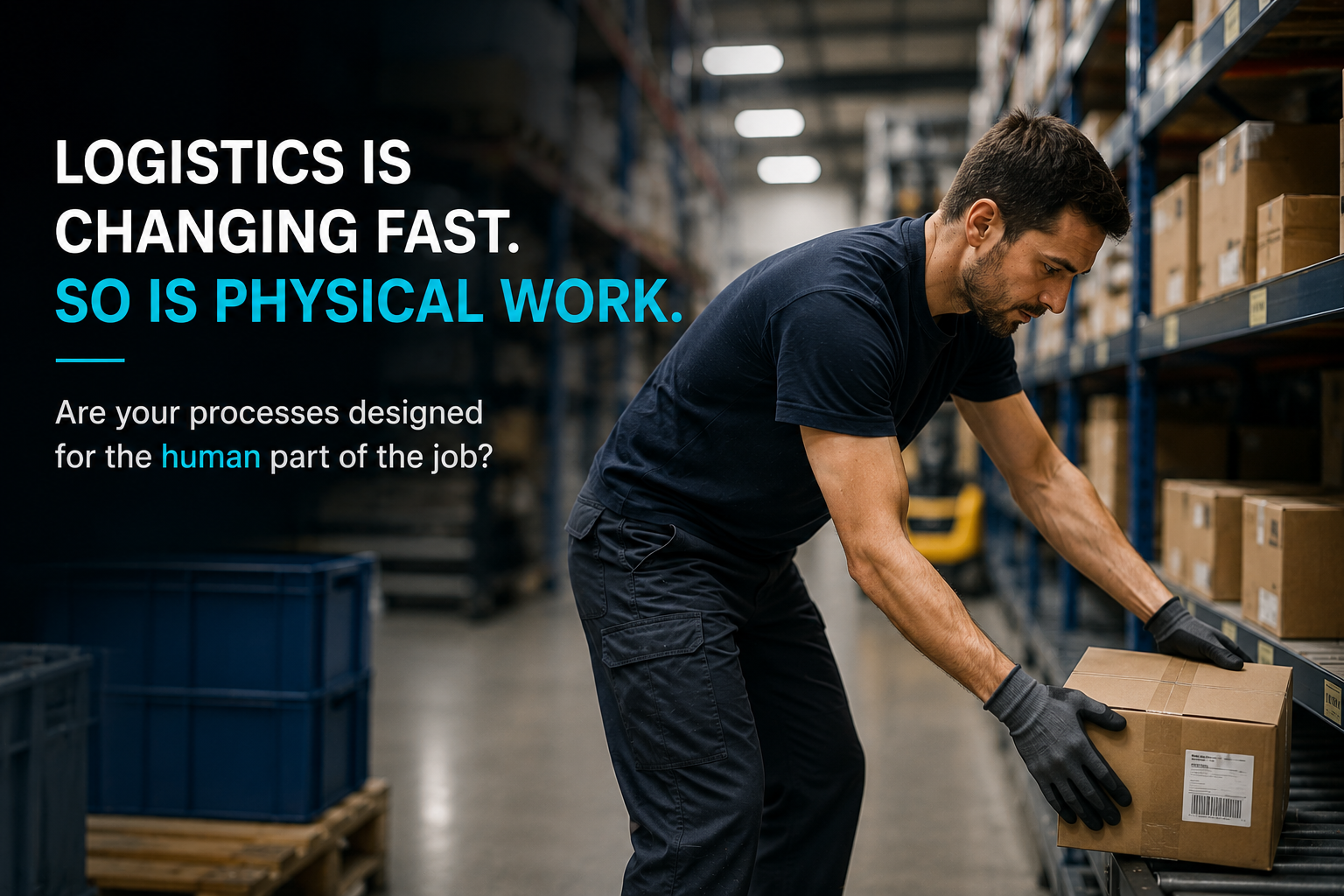
For years, logistics companies have invested heavily in making operations faster, more predictable, and more automated. Conveyor systems move goods between process steps, autonomous mobile robots reduce transportation tasks, and goods-to-person systems bring products directly to picking stations. Warehouse management systems continuously optimize inventory locations, routes, and order sequences.
Yet one part of the operation remains difficult to automate completely: human physical work.
Employees still pick individual products, handle irregular items, replenish automated systems, resolve exceptions, load vehicles, pack orders, and perform tasks that require flexibility and judgment. As logistics systems evolve, these activities evolve with them.
This is why ergonomics in logistics is becoming relevant in a new way.
In January 2026, Occupational Health & Safety described ergonomics as an emerging critical safety issue in U.S. logistics, pointing to challenges including repetitive work, manual material handling, fatigue, and workplace design.
The important development is not simply that warehouses still involve ergonomic risks. That has been understood for decades. What deserves closer attention is how logistics transformation itself is changing the physical work performed by people.
Automation does not simply remove manual work. It redistributes it.
And that means the ergonomics of an automated warehouse can look very different from the ergonomics of a conventional one.
The relationship between automation and ergonomics is often presented as straightforward: if machines perform more physical work, employees experience less physical strain.
In many situations, that is true.
An autonomous mobile robot can reduce the distance an employee needs to walk. A palletizing robot can remove repeated heavy handling. Conveyor systems can eliminate the need to manually transport goods between work areas. Automated storage systems can bring products directly to an operator instead of requiring employees to travel through long picking aisles.
These changes can remove meaningful physical demands from a process.
However, the work that remains can become more concentrated.
Consider a traditional picking operation in which an employee walks through a warehouse to collect products. Walking represents a substantial part of the work cycle, creating natural variation between individual picks.
In a goods-to-person system, the employee may remain at one station while products continuously arrive.
Walking decreases, but the number of handling cycles performed at the station can increase considerably.
The ergonomic question has therefore changed. Instead of primarily asking how much employees walk or carry, the company may now need to understand how often employees reach, turn, bend, or perform similar movements within a much denser work cycle.
Automation has improved one aspect of the process while creating a different physical work profile.
This points to a characteristic of modern logistics that deserves more attention: process density.
Logistics optimization often removes waiting, unnecessary travel, and idle time from a workflow. From an operational perspective, this makes sense. A process that previously required 60 seconds may now require 40. Material arrives exactly when needed, walking distances decrease, and automated systems coordinate the next task.
The same improvement can change the physical rhythm of work.
If a manual movement remains necessary but the time between repetitions becomes shorter, the employee may perform considerably more repetitions during the same working period.
This does not mean that faster processes are inherently ergonomically worse. Nor does it mean that automation should be slowed down for ergonomic reasons.
It means that throughput and physical workload should not be assumed to move in the same direction.
A process can become operationally more efficient while simultaneously changing the type, frequency, or distribution of physical demands experienced by employees.
For logistics managers, this creates a new design question: when process efficiency improves, how does the remaining human work change?
Another consequence of automation is that human work increasingly concentrates around tasks that machines cannot easily perform.
Standardized movements are comparatively suitable for automation. Irregularity is more difficult.
Employees may therefore increasingly handle damaged products, unusual package dimensions, exceptions, replenishment activities, maintenance-related tasks, mixed loads, or situations requiring judgment and flexibility.
These activities can have very different physical characteristics from the highly standardized processes surrounding them.
This creates an interesting paradox. The most automated part of a logistics operation may be highly predictable, while the remaining manual tasks become more variable.
From an ergonomics perspective, variability matters because an assessment of the standard process may not capture the physical demands created by exceptions.
A workstation may function well during normal product flow but require employees to reach, lift, reposition, or intervene differently whenever the automated system encounters something outside its expected parameters.
As automation increases, understanding these human exception tasks may become increasingly important.
This is particularly relevant when companies open new distribution centers or redesign existing operations.
New facilities provide an opportunity to improve both operational performance and working conditions. They also introduce new combinations of technology, workflows, workstations, and human tasks.
The assumption that a modern facility will automatically be more ergonomic because it contains newer technology can therefore be misleading.
The better question is whether ergonomics was considered while the new process was being designed.
The recent Occupational Health & Safety article makes a similar point, arguing that ergonomic considerations should be integrated during facility and workstation design rather than addressed only after operations begin.
This changes the timing of ergonomics.
Traditionally, an ergonomic assessment might take place after a workstation has been installed and employees have started using it. If problems are identified, the organization then considers modifications.
In a new logistics operation, there is an opportunity to reverse that sequence.
Before rollout, teams can examine which manual tasks will remain after automation, where employees will interact with machines, how materials will be presented, which tasks will repeat most frequently, and what happens when the process does not operate under ideal conditions.
Ergonomics then becomes an input into process design rather than an evaluation performed after the process is complete.
Logistics processes also rarely operate at one consistent level of demand throughout the year.
Black Friday, Christmas, promotional periods, seasonal demand, product launches, or unexpected supply-chain disruptions can substantially change warehouse activity.
A workstation designed around average demand may therefore operate differently during peak periods.
Employees may perform more repetitions, temporary workers may enter the process, overtime may increase, and normal task allocation can change. Activities that are relatively infrequent during normal operations may become routine during periods of exceptional demand.
The OHS article specifically highlights fatigue and the potential impact of long shifts, overtime, and peak seasons on ergonomic risk.
For logistics operations, this raises an important question: Should ergonomic performance be evaluated under average conditions or under the conditions that place the greatest demand on the system?
The answer will depend on the process, but relying only on normal-volume conditions can leave an important part of the operational reality unexplored.
Peak readiness should therefore not be considered only in terms of inventory, staffing, equipment capacity, and throughput. For physically demanding operations, it can also include understanding how peak volume changes human work.
Another consequence of changing logistics systems is that traditional job descriptions may become less useful for understanding physical workload.
Two employees may both be classified as warehouse operatives while performing completely different types of physical work.
One works at a goods-to-person picking station. Another replenishes the automated storage system. A third handles oversized products that cannot enter the automated flow. A fourth resolves exceptions and moves between several process areas.
Their job titles may be identical, but their physical work is not.
This matters because ergonomic risk exists at the level of the task and process, not simply at the level of the occupation.
As logistics systems become more specialized, companies may therefore need to think about ergonomics in the same way they think about process performance.
Operations teams rarely ask whether "warehouse productivity" is good or bad without breaking the process into receiving, put-away, picking, packing, replenishment, and shipping.
Physical workload deserves similar specificity.
Instead of asking whether a warehouse is ergonomic, the more useful question is which activities within the warehouse create relevant physical demands and how those activities interact with the wider process.
As automation increases, more warehouse employees work directly at the boundary between human and machine.
This interface is not only a software or engineering question.
It is also an ergonomic one.
The height at which an automated system presents a container affects the movement required to access it. The depth of a tote influences reaching distance. The position of screens, controls, labels, and products shapes how employees interact with the workstation. The speed at which items arrive influences the rhythm of repeated movements.
A technically efficient interface can therefore still create unnecessary physical demands.
This is particularly important because automated workstations are often replicated.
A small design issue at one manual workstation affects one workplace. The same issue incorporated into the design of 50 identical automated picking stations becomes a much larger operational problem.
The reverse is also true.
An ergonomic improvement made during the design stage can scale across every workstation built from the same specification.
This is one reason ergonomics can create disproportionate value when considered early in automation projects.
Warehouse automation projects are normally evaluated against defined requirements.
Does the system achieve the expected throughput? Is accuracy acceptable? Does the equipment integrate correctly with the warehouse management system? Can it handle the required product range? Is uptime sufficient?
Ergonomics can be treated in a similar way.
Before a new system is fully deployed, companies can define how human interaction with the process should be evaluated. This might include the accessibility of materials, workstation adjustability, handling requirements, repetitive manual tasks, or the physical demands associated with exception handling.
The specific criteria will differ by operation.
The important point is that ergonomics should not need to wait until employees begin reporting problems before it becomes relevant to project success.
When physical work is an intentional part of the process design, its conditions can also become part of the design requirements.
This has organizational consequences.
In many companies, automation projects are primarily driven by Operations, Engineering, IT, Procurement, and external technology providers. HSE may become involved later, particularly when formal risk assessments or workplace approvals are required.
That timing can limit the influence ergonomics has on the final process.
Once equipment has been purchased, layouts finalized, and performance assumptions incorporated into the business case, changing the physical design can become considerably more difficult.
Bringing ergonomics expertise into the project earlier allows different questions to be asked while there is still flexibility to act on the answers.
Which tasks will remain manual?
Where will people interact with automation?
What happens when the automated process fails?
How frequently will manual interventions occur?
What happens during peak throughput?
Can the workstation accommodate different workers?
These are simultaneously ergonomics questions and operational design questions.
The earlier they are answered, the less likely ergonomics is to become a retrofit exercise.
The increasing importance of ergonomics in logistics does not mean that HSE should take ownership of operational design.
It means that HSE and Operations increasingly need to understand the same process.
Operations may look at a picking station and see cycle time, accuracy, capacity, and throughput.
An ergonomist may look at the same station and see reaching distance, repetition, working height, task variation, and manual handling requirements.
Neither perspective describes the entire system.
A process can meet its throughput target while creating unnecessary physical demands. Equally, an ergonomic intervention that ignores operational reality may be difficult to implement or sustain.
The strongest solutions therefore emerge when both perspectives influence the design.
This is why ergonomics in logistics is gradually becoming more than a traditional occupational safety topic. It is becoming one of the variables that determine whether a logistics process works sustainably in practice.
Logistics has become exceptionally good at measuring systems.
Companies know how goods move, where delays occur, how equipment performs, and where capacity is lost. Automation is extending this visibility and making operations increasingly predictable.
Human work remains more complex.
It adapts when technology changes. It fills gaps when automated systems cannot handle exceptions. It becomes more concentrated when unnecessary process steps disappear. It changes during peak periods and varies between different parts of the same facility.
That is why the current attention on ergonomics in logistics matters.
The opportunity is not simply to identify more ergonomic risks. It is to consider physical work as part of the transformation already taking place across logistics.
When a process is automated, companies can ask how human work changes.
When a new distribution center is designed, they can consider physical demands before the first shift begins.
When throughput increases, they can examine whether the frequency of remaining manual movements changes with it.
When an automated system is evaluated, human interaction can become part of the acceptance criteria.
This represents a different role for ergonomics.
Instead of correcting work after it has been designed, ergonomics can help shape the design itself.
For an industry built around continuous optimization, that may be the more important development behind the renewed focus on ergonomic safety in 2026.
Logistics operations are becoming faster, more automated, and more process-dense, while many activities still require human physical work. Automation can remove certain physical demands but can also change the frequency, concentration, and type of manual work that remains. This makes it increasingly important to consider ergonomics as logistics processes evolve.
Warehouse automation can reduce many ergonomic exposures by removing manual transport, heavy handling, or unnecessary walking. However, it does not automatically eliminate ergonomic risk. New repetitive tasks, human-machine interactions, replenishment activities, and exception handling can create different physical demands.
Automation changes how work is divided between people and technology. From an ergonomics perspective, companies should therefore evaluate not only which manual tasks automation removes, but also which human tasks remain or are newly created.
Considering ergonomics during warehouse design allows companies to address physical work before equipment, layouts, and processes become difficult to change. This is particularly relevant for repeated workstation designs, automated picking stations, material presentation, and human-machine interfaces.
Peak periods can increase repetition, overtime, staffing changes, and overall process intensity. As a result, the physical demands experienced during peak operations may differ from those observed under average operating conditions.
Ergonomics in modern logistics often requires collaboration between HSE, Operations, Engineering, automation teams, and employees performing the work. Each group sees a different aspect of the same process, making cross-functional involvement particularly valuable during process and facility design.
This article was prompted by Francesco José Addabbo's January 2026 article, “Ergonomics Emerges as a Critical Safety Issue in U.S. Logistics,” published by Occupational Health & Safety. The article highlights manual material handling, repetitive work, fatigue, peak-season demands, and the importance of integrating ergonomics into facility and workstation design.
The broader ergonomic principles discussed here are also consistent with guidance from the National Institute for Occupational Safety and Health (NIOSH), which recommends identifying and controlling ergonomic risk factors and emphasizes the value of addressing these factors through workplace and process design.
More Insights
August 18, 2026
How can warehouse managers determine whether an ergonomics tool will work in their operation? Learn how to evaluate solutions through real-world pilots, usability, workflow integration and privacy.
August 17, 2026
What can manufacturers learn from Nissan’s investment in ergonomics? Explore why physical workload is becoming an important part of production and workstation design.
