


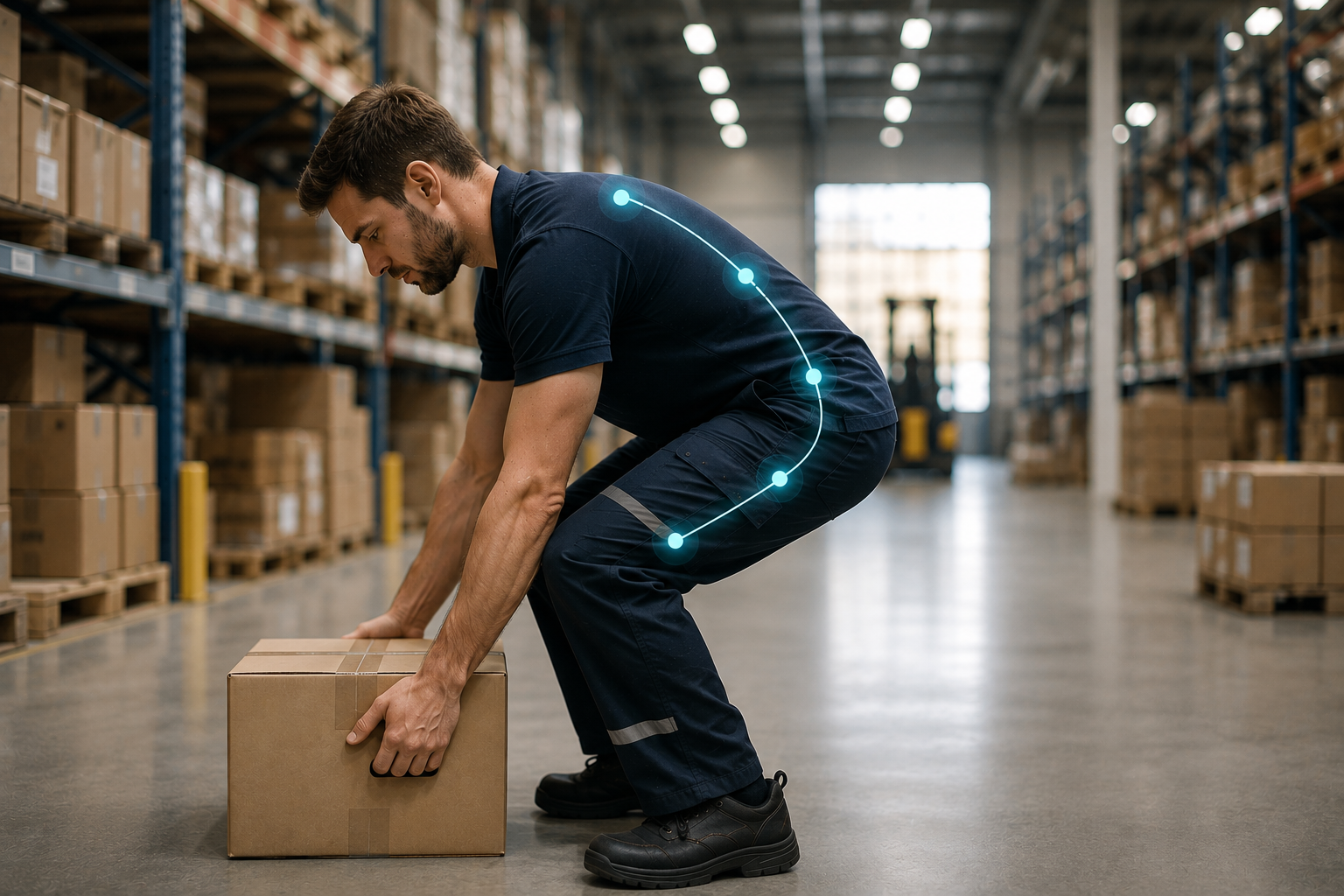
Most workers in physically demanding jobs already understand that repeated bending, twisting, overreaching, or poor lifting technique can increase physical strain. The challenge is not simply knowing what safer movement looks like, but applying that knowledge consistently while performing real work.
An employee may demonstrate good lifting technique during training and still move differently several hours into a demanding shift. A new worker may understand the principles explained during onboarding but struggle to apply them while simultaneously learning a new workstation, maintaining the required work pace, and responding to changing tasks. Over time, certain movement patterns can also become habitual without the worker consciously noticing them.
This creates an important challenge for workplace ergonomics. Traditional training usually separates learning from doing: employees receive instruction in one situation and are expected to remember and apply it later under very different working conditions.
AI wearable coaching introduces a different approach by bringing ergonomic feedback closer to the moment in which the movement actually occurs.
Wearable sensors can detect defined movement patterns while employees perform their normal tasks. When a relevant movement is identified, feedback can be provided immediately, for example through a subtle vibration. Rather than waiting for a supervisor, ergonomist, or future training session to address the movement, the employee receives information while the situation is still directly connected to what they have just done.
This difference may sound small, but from a learning perspective, the timing of feedback can fundamentally change how ergonomic guidance is translated into everyday movement.
AI wearable coaching combines body-worn sensor technology, automated movement analysis, and immediate feedback to support employees during physical work.
In a typical application, sensors capture information about movement or body orientation while software evaluates these signals according to defined ergonomic parameters. If a relevant movement pattern exceeds a predefined threshold, the worker can receive haptic, visual, or auditory feedback.
Haptic feedback is particularly suitable for industrial environments because it does not require employees to continuously monitor a screen. A short vibration can communicate information without significantly interrupting the task being performed.
This also illustrates an important distinction between ergonomic monitoring and ergonomic coaching. A system that only records movement data can help an organisation understand physical exposure and identify patterns. A coaching system goes one step further by returning information to the employee with the intention of supporting a change in movement behaviour.
The purpose is therefore not simply to measure how people move, but to create a feedback loop between movement, recognition, adjustment, and learning.
Consider a typical manual handling training session. An instructor explains how employees can approach a load, keep it closer to the body, avoid unnecessary trunk rotation, and use a more favourable movement technique when lifting.
Employees practise these principles, receive corrections, and usually leave the training with a clear understanding of what they have learned.
The challenge begins when they return to their normal working environment.
During a real shift, employees are not concentrating exclusively on ergonomics. They are processing orders, handling different products, interacting with equipment and colleagues, responding to interruptions, maintaining work quality, and operating within production requirements. As the shift progresses, fatigue and repetition can further influence how tasks are performed.
This does not mean that ergonomic training is ineffective. It means that knowledge and application are two different stages of behavioural change.
Training can teach employees why a movement matters and demonstrate alternatives. Coaching during real work can support employees while they attempt to apply those principles under actual operating conditions.
For this reason, AI wearable coaching should not necessarily be considered a replacement for traditional ergonomics training. The two approaches can serve different purposes within the same prevention strategy.
The relationship between an action and the feedback that follows it is important for learning.
Consider learning a new movement in sport. If a coach identifies a problem immediately after the movement and provides a correction, the athlete can connect the feedback directly with what they have just done and test an alternative during the next attempt. The same correction delivered several weeks later would be much harder to associate with the original movement.
Ergonomic feedback follows a similar principle.
In many workplaces, feedback is delayed. An ergonomist may observe a task and discuss the findings afterwards. A supervisor may notice an unfavourable movement and mention it later. Annual training may revisit movement principles months after problematic habits have developed.
Wearable coaching can shorten this feedback loop considerably. The movement occurs, the system recognises a predefined pattern, feedback is provided, and the worker has an opportunity to adjust during the next repetition.
Scientific research into wearable systems with haptic feedback supports the potential of this approach. Studies have shown that real-time feedback can influence movement behaviour and reduce exposure to certain unfavourable postures under specific conditions.
However, this evidence should be interpreted carefully. Demonstrating that feedback changes a movement is not the same as proving that a wearable prevents musculoskeletal disorders or workplace injuries. MSDs have multiple causes, and no single intervention can eliminate every contributing factor.
The more defensible conclusion is that real-time feedback can provide an additional mechanism for supporting ergonomic learning and behavioural change when movement technique is a relevant and modifiable part of physical exposure.
It is easy to describe wearable coaching as a technology that vibrates whenever an employee performs a high-risk movement. That description is technically understandable but misses the actual purpose of coaching.
The vibration itself does not make the movement safer. It provides information that the worker must learn to interpret and act upon.
Imagine that feedback is configured for excessive trunk flexion during a particular manual handling task. When the employee first receives the signal, they may consciously recognise that they have bent further forward than intended. During the next repetition, they can experiment with positioning themselves closer to the load, changing the way they use their hips and knees, or approaching the task differently.
Through repeated practice, the relationship between movement and feedback can become increasingly familiar. The employee may begin to recognise the movement before receiving the signal and eventually adopt an alternative technique more consistently.
This means that successful AI wearable coaching should not aim to make employees permanently dependent on technology. The longer-term objective is to support awareness and learning so that safer movement strategies become easier to recognise and reproduce during normal work.
In that sense, the technology acts as a coach rather than a permanent warning system.
Another common misconception is that wearable coaching is essentially a digital system for correcting "bad posture."
Human movement is considerably more complex.
There is rarely one perfect posture that every employee should maintain throughout an entire working day. People have different body dimensions, tasks change, loads vary, and movement itself is necessary. Even a seemingly favourable posture can become physically demanding when it is maintained for too long or repeated hundreds of times.
A more useful coaching question is therefore not whether a worker is standing or moving "correctly" in an absolute sense.
Instead, organisations should ask:
Which movement patterns create unnecessary physical strain during this particular task, and can the employee realistically perform the task differently?
This distinction prevents wearable technology from becoming a simplistic posture alarm and keeps the focus on meaningful ergonomic exposure.
AI wearable coaching is not equally suitable for every ergonomic problem. It is most relevant when movement technique contributes meaningfully to physical exposure and when the employee has a realistic opportunity to modify that movement.
Manual handling is a useful example. If workers repeatedly use a movement strategy that involves unnecessary trunk flexion or rotation, immediate feedback may help them recognise the pattern and practise an alternative technique.
The same principle can be useful during onboarding. New employees often receive substantial information within a short period, and movement technique is only one of many things they must remember. Wearable coaching can extend ergonomic guidance beyond the initial training session and into the period in which employees are becoming familiar with real working conditions.
Another application is targeted behavioural intervention. If an ergonomics analysis has already identified a specific movement pattern as an important contributor to physical exposure, real-time coaching can be used to investigate whether employees are able to modify that movement during their normal work.
The important point is that the intervention begins with a clearly defined ergonomic problem rather than with the technology itself.
Understanding when not to use wearable coaching is just as important.
Imagine a picking station where frequently handled products are permanently stored close to floor level. Employees must repeatedly bend deeply because the layout gives them no realistic alternative.
A wearable could detect every deep bend and provide immediate feedback, but the worker would have very little ability to respond. The system would repeatedly identify a problem that can only be solved through a change in work design.
In this situation, raising the material, changing the container, modifying the rack configuration, or redesigning the process may be considerably more appropriate.
The same principle applies when excessive reach is caused by workstation geometry, when a load is too heavy for the existing manual handling process, or when employees must twist because there is insufficient space to reposition their bodies.
AI wearable coaching should never become a technological substitute for good ergonomic design.
A useful distinction is whether the movement is primarily chosen or imposed. When workers have realistic alternatives and movement technique contributes to exposure, coaching may be valuable. When the task itself forces the problematic movement, the priority should be to change the task.
In practice, both factors can also exist simultaneously. A workstation may benefit from engineering improvements while employees also benefit from learning a better technique for the movements that remain.
Wearable coaching can also reveal something that is easy to miss when the technology is viewed only as a worker-level intervention.
Suppose employees at one workstation repeatedly receive feedback for the same movement. At first, the obvious interpretation may be that these workers need additional coaching.
However, if different employees encounter the same movement pattern in the same part of the process, the problem may not primarily lie with individual technique.
The material could be positioned too low. A frequently used component might require excessive reach. The sequence of the task could encourage unnecessary trunk rotation. A container may become increasingly difficult to access as it empties.
Aggregated movement patterns can therefore generate valuable questions about how work itself is organised.
This creates two different levels of potential value. At the individual level, feedback can support employees in recognising and modifying certain movement patterns. At the organisational level, recurring patterns can help ergonomics and operations teams investigate why those movements continue to occur.
This second level is particularly important because it prevents wearable coaching from placing the entire responsibility for ergonomic risk on the worker.
If immediate feedback can support learning, providing more feedback might initially seem beneficial.
In practice, excessive feedback can undermine the intervention.
A device that vibrates constantly throughout a shift can become distracting or irritating. Employees may also become accustomed to the signal and gradually stop paying attention to it. This phenomenon is particularly relevant in repetitive industrial work, where poorly calibrated thresholds could generate large numbers of alerts.
Effective coaching therefore requires decisions about what deserves feedback, when it should be delivered, and how frequently an employee needs to receive it.
Not every movement needs an intervention.
Recent research into vibrotactile ergonomic feedback also illustrates why careful implementation matters. While studies have demonstrated improvements in certain posture-related outcomes, some experimental conditions have also produced trade-offs such as increased muscular activity or changes in concurrent task performance.
The lesson is not that haptic feedback should be avoided. Rather, it shows why wearable coaching should be treated as an ergonomic intervention that needs to be evaluated in context.
The objective is not to maximise the number of corrections.
It is to provide enough relevant feedback to support useful learning without creating unnecessary interference with the work itself.
This leads to another important question: should workers receive the same amount of feedback indefinitely?
Probably not.
During an initial learning phase, relatively frequent feedback may help employees understand which movements trigger the system and how alternative techniques affect the result.
As employees become more familiar with those movements, the need for external feedback may decrease.
This suggests that AI wearable coaching can be viewed as a progressive learning process. Early feedback establishes awareness, repeated practice supports behavioural adaptation, and later stages can focus on reinforcing the movement without unnecessarily interrupting employees.
A successful coaching program should therefore not automatically be judged by how often the technology provides feedback.
In some cases, a declining need for feedback may be one of the clearest indicators that learning is taking place.
The goal is not vibration.
The goal is behavioural adaptation.
The term AI is increasingly attached to workplace technology, sometimes without explaining what artificial intelligence actually contributes.
A sensor that measures an angle and vibrates whenever a fixed threshold is crossed does not necessarily require AI.
The more meaningful role of artificial intelligence appears when systems interpret movement patterns in context rather than treating every sensor reading as an isolated event.
Different activities can involve very different movement requirements. A particular trunk angle may represent unnecessary exposure during one repetitive task but occur briefly and legitimately during another. Movement frequency, duration, sequence, task type, and previous patterns can all change the meaning of an individual measurement.
AI-based analysis can help distinguish these contexts and identify patterns across larger amounts of movement data.
This matters because effective coaching depends not only on recognising movement, but also on determining when feedback is useful.
The future of AI wearable coaching is therefore unlikely to be a device that simply tells workers to "stand straighter." More useful systems will increasingly need to understand which movements deserve attention, when an intervention can help, and when no feedback is necessary.
Workplace wearables also introduce an issue that cannot be separated from their technical performance: employee trust.
A device intended to improve ergonomics can quickly be perceived very differently if employees believe it is also monitoring productivity, location, or individual performance.
Research into employee acceptance of workplace wearables suggests that perceived usefulness, transparency, employee involvement, and organisational safety climate can influence willingness to use such technology.
For companies implementing AI wearable coaching, this has practical consequences.
Employees should understand what the system measures, why those measurements are necessary, what information is not collected, how the data will be used, and who can access it.
Collecting additional information simply because the technology makes it possible can undermine the purpose of the intervention.
If the objective is ergonomic coaching, the data architecture and implementation process should reflect that objective.
Privacy is therefore not merely a legal or IT requirement added at the end of a project. It is part of whether employees perceive the technology as a safety tool designed to support them or as another form of workplace monitoring.
Organisations considering AI wearable coaching should resist the temptation to begin with product features.
The first step is defining the ergonomic problem.
Which physical exposure should change? What movement contributes to that exposure? Can employees realistically modify the movement? What would an improved movement strategy look like?
Only after these questions have been answered does it make sense to evaluate whether wearable coaching is an appropriate intervention.
A pilot should then examine more than technical functionality. Companies should assess whether relevant movements are recognised reliably, whether employees understand the feedback, whether they can respond without disrupting the task, and whether the system remains useful under normal operating conditions rather than only during a controlled demonstration.
Most importantly, organisations should evaluate whether the targeted physical exposure actually changes.
A successful pilot is not one in which every device connects correctly and employees generate large amounts of data.
It is one in which the intended ergonomic outcome improves without introducing new physical, operational, or organisational problems.
AI wearable coaching combines body-worn sensors, automated movement analysis, and real-time feedback to support employees during physical work. Depending on the system, feedback may be provided through vibration, sound, or visual signals when defined movement patterns are detected.
Traditional ergonomic training usually teaches movement principles before employees return to their normal tasks. AI wearable coaching can provide feedback while the task is being performed. Training can therefore build knowledge, while real-time coaching can support employees in applying that knowledge under actual working conditions.
Studies suggest that vibrotactile feedback can support changes in posture and movement in certain tasks. However, feedback must be carefully configured because excessive or poorly targeted signals can lose their effectiveness over time.
To understand how ergonomic risks can be managed beyond individual interventions, continue with „Five Warehouse Safety Assumptions That Are Wrong“.
For manual handling specifically, „How to Prevent Lifting Injuries in Warehouse Operations: Match the Problem to the Right Prevention Measure“ examines when movement technique should be addressed and when the task itself needs to change.
More Insights

August 18, 2026
How can warehouse managers determine whether an ergonomics tool will work in their operation? Learn how to evaluate solutions through real-world pilots, usability, workflow integration and privacy.
August 17, 2026
What can manufacturers learn from Nissan’s investment in ergonomics? Explore why physical workload is becoming an important part of production and workstation design.
